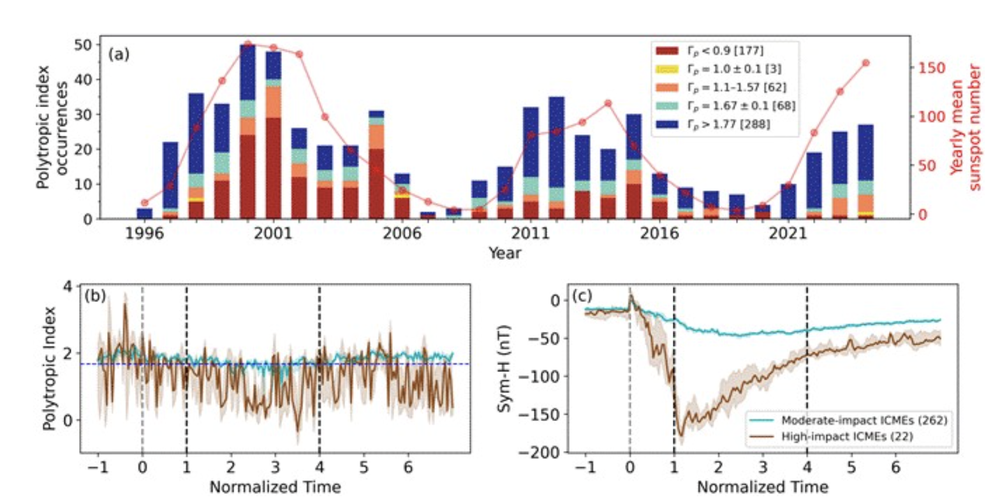
Indian astrophysicists have uncovered new insights into how large solar eruptions called Interplanetary Coronal Mass Ejections (ICMEs) evolve thermally during their journey from the Sun to the Earth, and how this thermal state influences their potential to disturb Earth’s magnetic environment that influence radio communications, aviation routes, and power grids.
This study was published in the Monthly Notices of the Royal Astronomical Society in a paper titled "Thermal properties of interplanetary coronal mass ejections at 1 au and their connection to geoeffectiveness across solar cycles 23–25", and is authored by Soumyaranjan Khuntia and Wageesh Mishra of IIA.
The PIB press release is here.
The DST press release is here.
The paper is here.