RESEARCH HIGHLIGHTS | IIA
TweetSDSS-V BHM: Evidence for a link between X-ray weakness and galaxy-scale ionised gas outflows in quasars
VIVEK, M
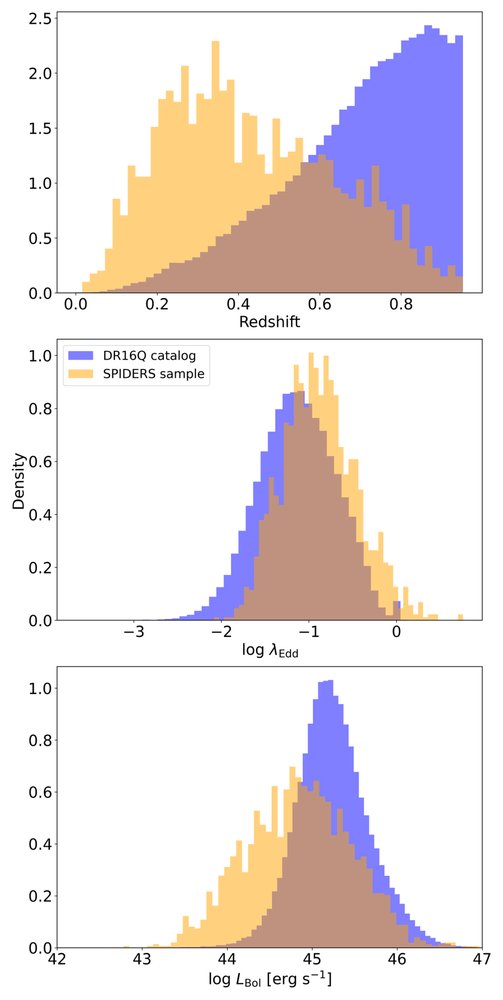
Active galactic nuclei (AGNs) are among the most powerful engines in the Universe. A central open question is how accretion physics, obscuration, and feedback are intertwined in shaping these systems. This paper presents an analysis of SDSS-V–eROSITA Data Level 1 (DL1) data from the 19th data release (DR19). The work is based on SDSS spectra for 2119 soft X-ray selected quasars (0 < z < 0.95), drawn from the eROSITA all-sky catalogue (eRASS1), and complemented by mid-infrared (MIR) data from the Wide-field Infrared Survey Explorer (WISE). We assessed the outflow strength using the W80 measurement of the [OIII] λ5007 emission line and derived the virial black hole mass from the broad Hβ emission line. The rest-frame 2–10 keV X-ray luminosity and the 6 μm MIR luminosity were used to determine the X-ray weakness, relative to established luminosity scaling relations. We compared the W80line width, X-ray luminosity, and black hole mass and report a weak negative trend between X-ray weakness and outflow strength for quasars with W80 ≥ 800 km s−1. These results support the interpretation that the observed X-ray weakness in AGNs may be linked to dense, nuclear-scale outflows.