RESEARCH HIGHLIGHTS | IIA
TweetSN 2021tsz: A luminous, short photospheric phase Type II supernova in a low-metallicity host
MRIDWEEKA SINGH
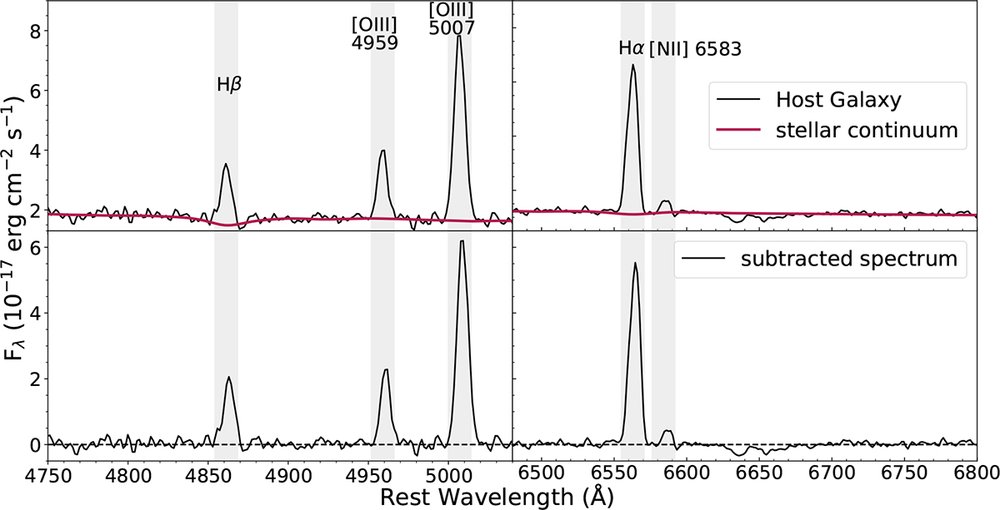
We present the analysis of the luminous Type II Supernova (SN) 2021tsz, which exploded in a low-luminosity galaxy. It reached a peak magnitude of −18.88 ± 0.13 mag in the r band and exhibited an initial rapid decline of 4.05 ± 0.14 mag (100 d)−1 from peak luminosity till ∼30 d. The photospheric phase is short, with the SN displaying bluer colours and a weak Hα absorption component–features consistent with other luminous, short-photospheric phase Type II SNe. A distinct transition from the photospheric to the radioactive tail phase in the V band–as is common in hydrogen-rich Type II SNe–is not visible in SN 2021tsz, although a modest ∼1 mag drop is apparent in the redder filters. Hydrodynamic modelling suggests the luminosity is powered by ejecta-circumstellar material (CSM) interaction during the early phases (<30 days). Interaction with 0.6 M of dense CSM extending to 3100 R reproduces the observed luminosity, with an explosion energy of 1.3 × 1051 erg. The modelling indicates a pre-SN mass of 9 M , which includes a hydrogen envelope of 4 M , and a radius of ∼1000 R . Spectral energy distribution analysis and strong-line diagnostics revealed that the host galaxy of SN 2021tsz is a low-metallicity, dwarf galaxy. The low-metallicity environment and the derived high mass loss from the hydrodynamical modelling strongly support a binary progenitor system for SN 2021tsz.