RESEARCH HIGHLIGHTS | IIA
TweetThe ALMA-QUARKS survey: Properties of hot molecular fragments in the massive protocluster IRAS 17233-3606
SHIVANI GUPTA
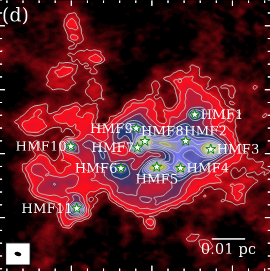
To investigate the physical mechanisms of fragmentation within the hot molecular core of the massive protocluster IRAS 17233-3606 (G351.78-0.54), we carried out a detailed analysis of continuum and lines using the Atacama Large Millimeter/submillimeter Array (ALMA) Band 3 data from the ATOMS survey and Band 6 data from the QUARKS survey. The low-resolution 3 mm data reveal a massive hot core millimeter source 1 (MM1) with a mass of ~81.3 M⊙, and a prominent ultracompact (UC) H II region, millimeter source 2 (MM2), while the high-resolution data resolve MM1 into 11 hot molecular fragments (HMFs). These HMFs exhibit hot (Trot = 100--310 K) CH3CN and CH3OH emission and high column densities (N H2 > 1023 cm-2), indicating their potential to form massive stars. Based on outflows, masers, H II regions, and f[CH3CN/CH3OH] abundance ratios, the evolutionary sequences of the 11 HMFs are categorized as Phases I to IV. The mean minimum-spanning tree (MST) separation (~1.8 × 10³ au) of the HMFs is nearly half of the thermal Jeans length (~3.3 × 10³ au). Together with the Q parameter Q = 0.77 and virial parameter αvir = 0.84 of MM1, these results suggest an evolutionary scenario in which fragmentation is initially driven by thermal instability, followed by global gravitational contraction and growth through active accretion. Meanwhile, feedback from the B2-type zero-age main-sequence (ZAMS) star and the UC H II region significantly influence the morphology and chemical properties of MM1 and MM2. This heterogeneity highlights the role of diverse physical processes taking place in high-mass protoclusters.