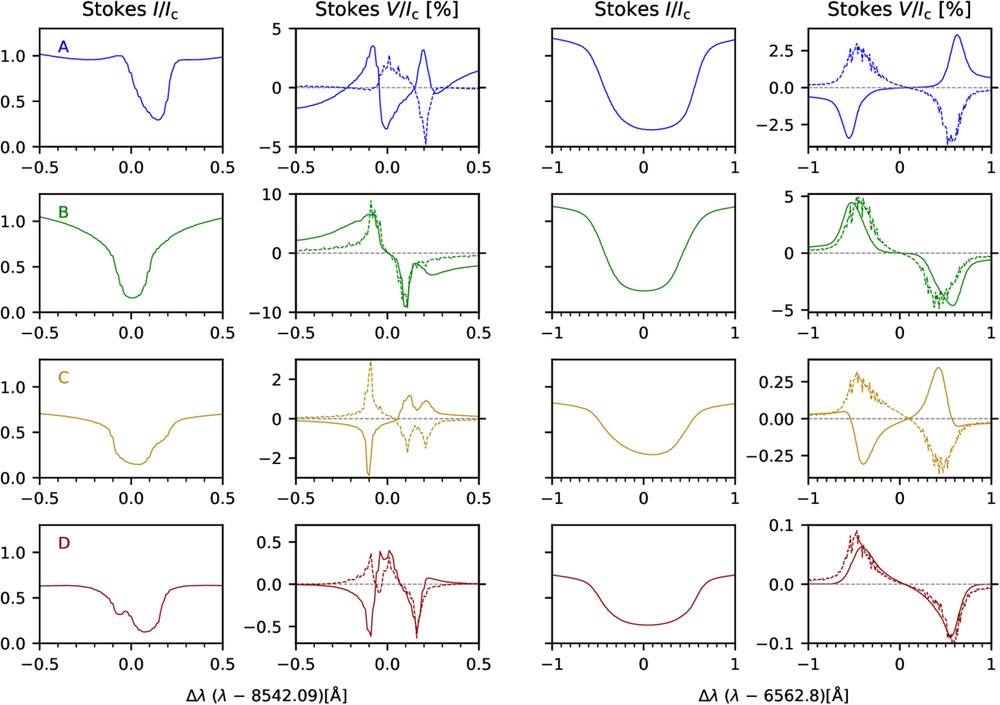
We explore the diagnostic potential of the Hα line for probing the chromospheric magnetic field using a realistic 3D radiative magnetohydrodynamic (rMHD) model. The Stokes profiles of the Hα line are synthesized through full 3D radiative transfer under the field-free approximation, alongside the Ca II 8542 Å and Fe I 6173 Å lines for comparison. The line-of-sight (LOS) magnetic fields are inferred using the weak-field approximation for the Hα and Ca II 8542 Å lines, while the Fe I 6173 Å line is analyzed through Milne-Eddington inversion techniques. The comparison between the inferred LOS magnetic field maps and the magnetic fields in the rMHD model revealed that the Hα line core primarily probes the chromospheric magnetic field at log 500 = −5.7, which corresponds to higher layers than the Ca II 8542 Å line core, which is most sensitive to conditions at log 500 = −5.1. On average, the Stokes V profiles of the Hα line core form 500 km higher than those of the Ca II 8542 Å line core. The Hα polarization signals persist after adding noise, and with noise at the level of 10−3 Ic, most simulated magnetic structures remain visible. These findings suggest that spectropolarimetric observations of the Hα line can provide complementary insights into the stratification of the magnetic field at higher altitudes, especially when recorded simultaneously with widely used chromospheric diagnostics such as the Ca II 8542 Å line.