RESEARCH HIGHLIGHTS | IIA
TweetThe Most Luminous Known Fast Blue Optical Transient AT 2024wpp: Unprecedented Evolution and Properties in the X-Rays and Radio
ANUPAMA, G. C
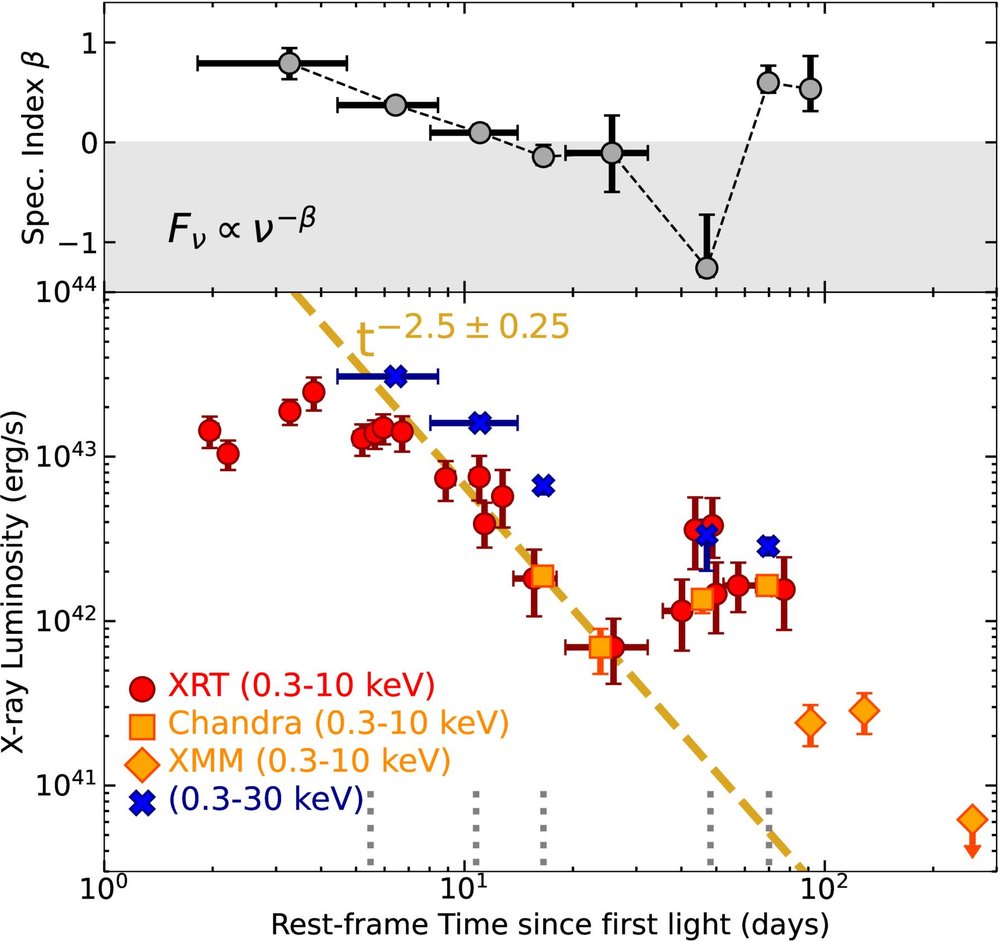
We present X-ray (0.3─79 keV) and radio (0.25─203 GHz) observations of the most luminous fast blue optical transient (LFBOT) AT 2024wpp at z = 0.0868, spanning 2─280 days after first light. AT 2024wpp shows luminous (LX ≍ 1.5 × 1043 erg s−1), variable X-ray emission with a Compton hump peaking at δt ≍ 50 days. The X-ray spectrum evolves from a soft (Fν ∝ ν−0.6) to an extremely hard state (Fν ∝ ν1.26) accompanied by a rebrightening at δt ≍ 50 days. The X-ray emission properties favor an embedded high-energy source shining through asymmetric expanding ejecta. We detect radio emission peaking at L9 GHz ≍ 1.7 × 1029 erg s−1 Hz−1 at δt ≍ 73 days. The spectral evolution is unprecedented: the early millimeter fluxes rise nearly an order of magnitude during δt ≍ 17─32 days, followed by a decline in spectral peak fluxes. We model the radio emission as synchrotron radiation from an expanding blast wave interacting with a dense environment ( Ṁ∼10−3M⊙yr−1 for vw = 1000 km s−1). The inferred outflow velocities increase from Γβc ≍ 0.07c to 0.42c during δt ≍ 32─73 days, indicating an accelerating blast wave. We interpret these observations as a shock propagating through a dense shell of radius ≍1016 cm and then accelerating into a steep density profile ρCSM(r) ∝ r−3.1. All radio-bright LFBOTs exhibit similar circumstellar medium (CSM) density profiles (ρCSM ∝ r−3), suggesting similar progenitor processes. The X-ray and radio properties favor a progenitor involving super-Eddington accretion onto a compact object launching mildly relativistic disk wind outflows.