RESEARCH HIGHLIGHTS | IIA
TweetThe nature of optical afterglows without Gamma-ray bursts: Identification of AT2023lcr and multiwavelength modeling
ANUPAMA, G. C
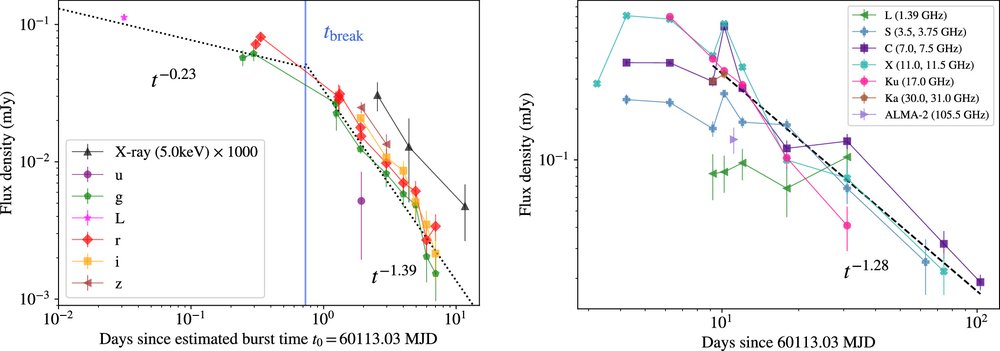
In the past few years, the improved sensitivity and cadence of wide-field optical surveys have enabled the discovery of several afterglows without associated detected gamma-ray bursts (GRBs). We present the identification, observations, and multiwavelength modeling of a recent such afterglow (AT2023lcr), and model three literature events (AT2020blt, AT2021any, and AT2021lfa) in a consistent fashion. For each event, we consider the following possibilities as to why a GRBwas not observed: (1) the jet was off-axis; (2) the jet had a low initial Lorentz factor; and (3) the afterglow was the result of an on-axis classical GRB (on-axis jet with physical parameters typical of the GRB population), but the emission was undetected by gamma-ray satellites. We estimate all physical parameters using afterglowpy and Markov Chain Monte Carlo methods from emcee. We find that AT2023lcr, AT2020blt, and AT2021any are consistent with on-axis classical GRBs, and AT2021lfa is consistent with both on-axis low Lorentz factor (Γ0 ≈ 5–13) and off-axis (θobs = 2θjet) high Lorentz factor (Γ0 ≈ 100) jets.