RESEARCH HIGHLIGHTS | IIA
TweetWild behaviour near the finish line: The Type Ibn SN 2020able and its stratified environment
MRIDWEEKA SINGH
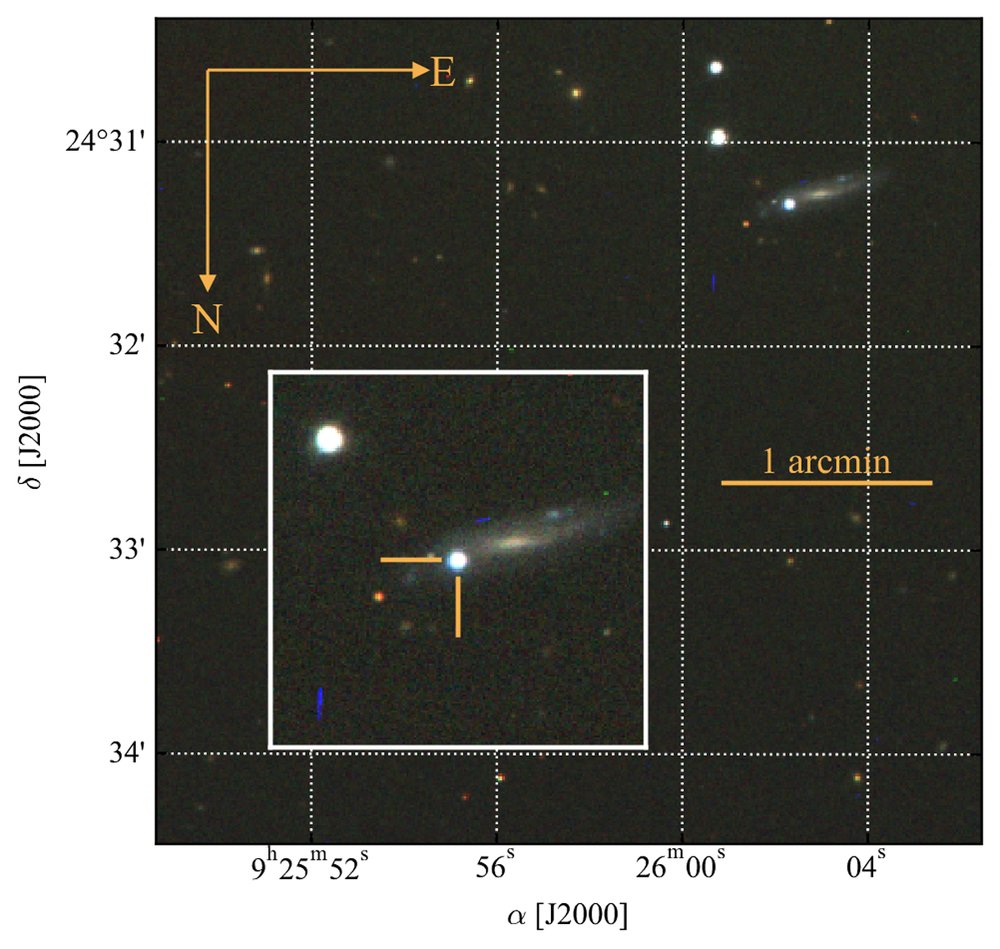
We present spectrophotometric observations of the Type Ibn supernova SN 2020able, along with a comprehensive analysis and modelling of its evolution. The transient occurred in SDSS J092602.93+243115.1, a faint host galaxy characterised by significantly subsolar metallicity (12 + log(O/H) ≃ 8.28 dex). The early photometric evolution and high peak luminosity (Lpeak ≃ 4.4 × 1043 erg s−1) indicate an efficient conversion of ejecta kinetic energy into radiation via interaction with the circumstellar medium. Light-curve modelling suggests that this interaction involves ejecta with a mass of Mej ≃ 1.3 M☉ impacting a shell of MCSM ≃ 0.6 M☉. However, interaction is found to be geometrically and temporally confined within a few days after explosion, with the later evolution of the transient being dominated by the free expansion of the ejecta. Spectroscopic analysis reveals a complex, stratified, circumstellar environment. In addition to the innermost shocked region, we identify two additional He-rich shells: a dense inner one (ne ≃ 1.4 × 109 cm−3) located at R ≳ 9.3 × 1014 cm, and a more extended outer component reaching Rout ≃ 3.3 × 1015 cm and expanding at approximately 1.2 × 10³ km s−1. The physical parameters of the former suggest it was produced by a discrete, pre-supernova eruptive event similar to that of SN 2006jc, which expelled approximately 1.8 × 10⁻² M☉ of material. Conversely, the expansion velocity of the outermost shell is consistent with the escape velocity of Wolf–Rayet stars, pointing towards a late WN- to WC-type progenitor as the most viable candidate for SN 2020able.