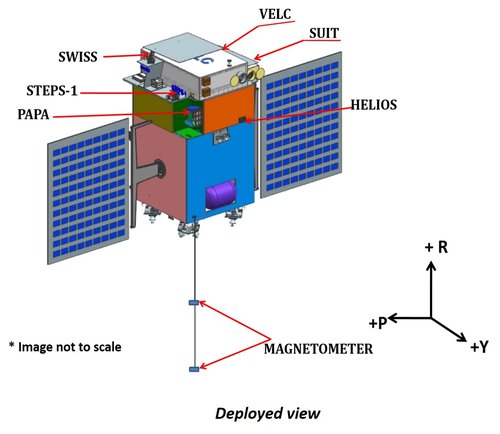
Aditya-L1 is India's first dedicated scientific mission to study the Sun and the solar corona. Initially, this mission was envisaged as Aditya-1, with a 400 kg-class satellite carrying one payload—the Visible Emission Line Coronagraph (VELC)—and was planned to be launched into an 800 km low Earth orbit.
Later, it was decided to place the satellite in a halo orbit around the first Lagrangian point (L1) of the Sun–Earth system, which is approximately 1.5 million km from Earth. This location allows for continuous, 24x7 observation of the Sun without any eclipses, and also enables fuel-efficient spacecraft operations. Therefore, the mission was renamed the Aditya-L1 mission.
Aditya-L1 was launched on 2 September 2023 using a PSLV-XL C-57 from Sriharikota launch pad, SHAAR, India. After 126 days of travel, Aditya-L1 was
inserted into a halo orbit around the L1 point on 6 January 2024.
In addition to VELC, Aditya-L1 carries three other remote-sensing payloads:
- SUIT – Solar Ultraviolet Imaging Telescope
- SoLEXS – Solar Low Energy X-ray Spectrometer
- HEL1OS – High Energy L1 Orbiting X-ray Spectrometer
It also hosts three in-situ payloads:
- ASPEX – Aditya Solar Wind Particle Experiment
- PAPA – Plasma Analyser Package for Aditya
- Magnetometer
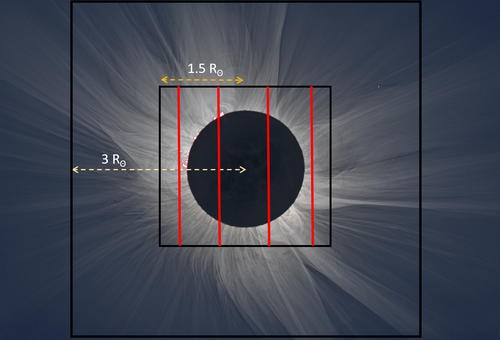
VELC onboard Aditya-L1 is an internally occulted coronagraph designed to observe the solar corona simultaneously in imaging, spectroscopy, and spectropolarimetry modes. The imaging channel operates at 500 nm with a field of view (FoV) ranging from 1.05 to 3 solar radii. The spectroscopy channels operate at 530.3 nm, 789.2 nm, and 1074.7 nm within an FoV of 1.05 to 1.5 solar radii. The IR channel at 1074.7 nm is equipped with a spectropolarimetric mode of operation.