VELC: Observing Modes
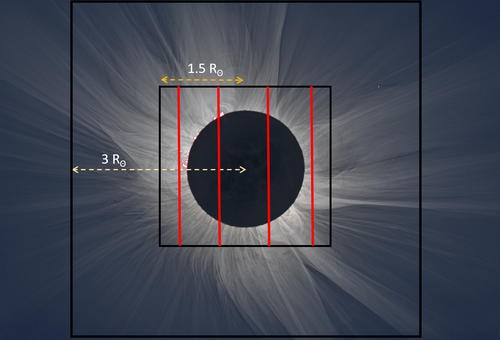
VELC is capable of performing observations in proposal mode as well as in default mode. In the proposal mode, an observer submits a proposal through an online submission form with a desired set of observing parameters such as cadence, exposure time, spatial binning, etc. One can plan the observations choosing either 1, 2, 3, or all 4 detectors. During the performance verification (PV) phase observations will be planned by the payload team and during the guaranteed time (GT) phase observations will be planned by the IIA science team (PI institute). Calibration observations will be planned by the payload team whenever required.
Continuum imaging observations
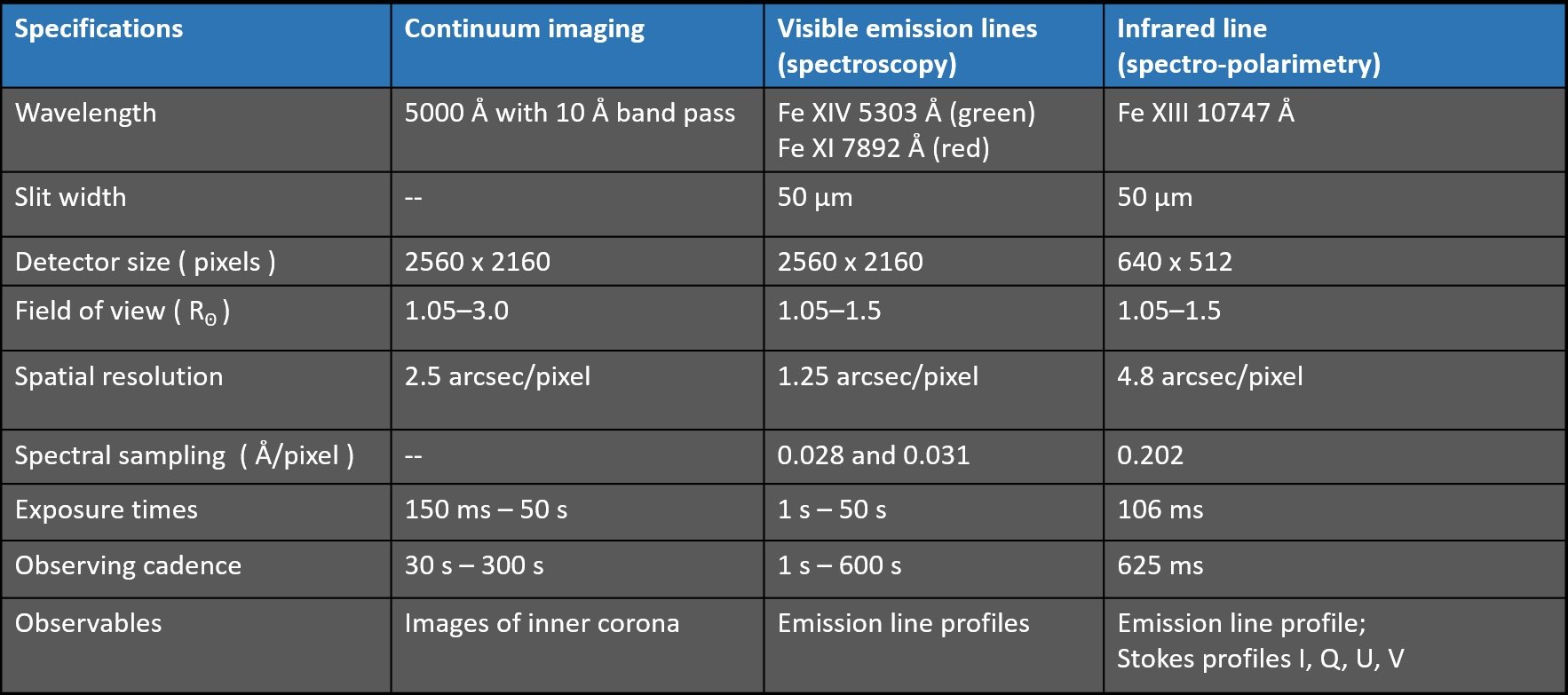
Coronal imaging observations (1.05-3 Rs) are obtained at 2.5 arcsec/pixel spatial resolution and a cadence of integer multiples of one minute. The exposure time is 10-50 ms. An onboard CME detection algorithm is used to observe the corona at a high cadence. Depending on the success rate, the CME detection algorithm will be replaced by the default mode of observations round the clock however at reduced spatial resolution and low cadence.
Spectroscopic observations
There are basically two modes of observations, (i) Sit and stare (ii) Raster scan observations. Observations in three emission lines are possible simultaneously. One can choose 1, 2 or all the 3 emission line for observations.
- Sit and stare mode:Spectral parameters are given in the above Table. There are 4 entrance slits of the spectrograph separated by 12 arcminutes, and the image is made to move on these slits using a linear scan mechanism (LSM). Parameters of observations can be chosen as listed for continuum observations. Facility to choose the location of observation on the solar corona within FOV of 1.5 solar radii defining the position of LSM. Then spectra by defining the exposure time, cadence, duration of observation (number of spectra) and other parameters can be obtained to study the temporal variations or spatial variations along the slit.
- Raster scan mode:The setting of parameters of observations is similar to sit and stare mode. In this mode, the LSM moves the image at a defined interval. During the interval the spectrum is recorded and saved. The number of steps of LSM movement (number of spectra) can be defined. Using these spectra one can make an image of the solar corona, in intensity, FWHM and Doppler velocity. Provision is made to take multiple raster scans with the same observation settings.
Spectro-polarimetric observations
These are planned only in 10747 Å [Fe XIII] infrared emission line. All the parameters of these observations are fixed. Exposure time is 103 ms with a high gain of the detector.