Science Objectives
Major science objectives of VELC are given below:
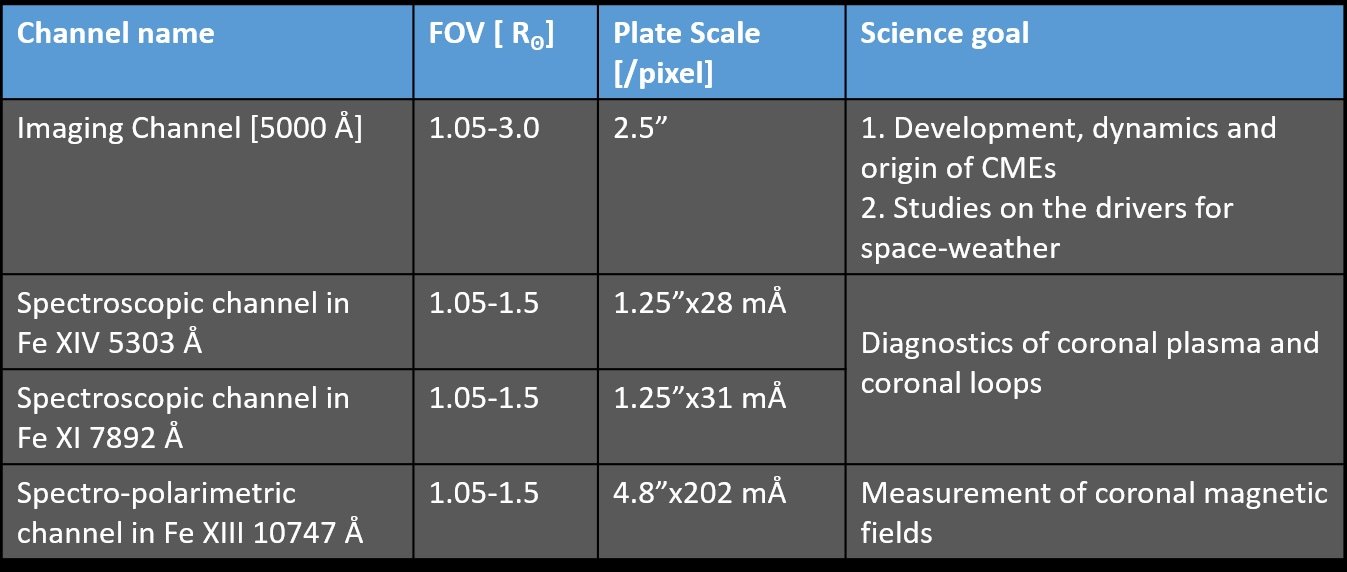
- Diagnostics of the corona and coronal loop plasma (Temperature, Velocity, & Density).
- Heating of the corona and solar wind acceleration.
- Development, dynamics and origin of CME's.
- Dynamics of the large-scale transients
- Studies on the drivers for space weather.
- Measurement of coronal magnetic fields in the corona
Of the several possible scientific studies, representative science case studies are outlined as follows.
Continuum imaging observations
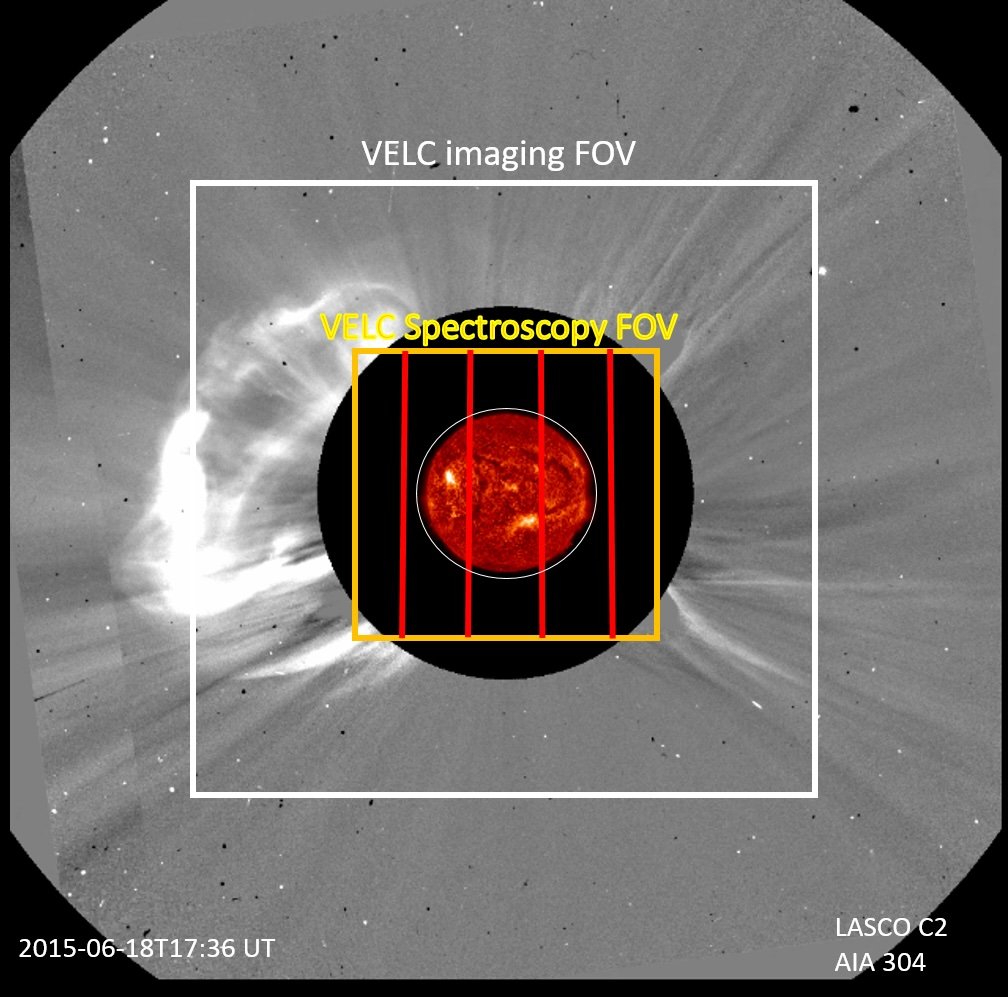
Continuum channel was designed to observe the solar corona in the FoV 1.05-3 solar radii with high cadence observations (148 msec). Further, observations from the L1 helps to observe coronal uninterruptedly. This enables us to understand coronal structures close to the limb. Further, it helps in understanding initial phase of CMEs and their propagation close to the Sun.
Spectroscopic observations
Simultaneous spectrographic observations in three lines, viz. 5303 Å [Fe XIV], 7892 Å [Fe XI], and 10747 Å [Fe XIII], provide unique and crucial information about the heating, dynamics, temperature, and density structure of the solar corona. These operate in two modes: sit-and-stare mode and raster scan mode. In the sit-and-stare mode, it is possible to place the slit at any location within the field of view (FoV) of 1.05–1.5 solar radii and acquire data continuously with high-cadence observations. Such data provide valuable information on peak intensities of lines, line widths, Doppler velocities, etc. From these observations, various physical processes occurring in the solar corona can be understood. Coronal dimming observations help in precisely determining the onset timings of coronal mass ejections (CMEs). In raster scan mode of observations, we can scan the full FoV, to make the raster scan images of the solar corona. These observations help us identify the long-standing structures of the corona.
Spectro-polarimetric Observations
Coronal magnetic fields are crucial for understanding the kinematics, dynamics, and structural evolution of the solar corona. However, despite having magnetic field information at photospheric heights for decades, direct observations of coronal magnetic fields remain challenging. Therefore, the spectropolarimetry channel of VELC at 10747 Å [Fe XIII] is designed to address this. It is capable of observing the full Stokes parameters of the corona. Stokes V observations provide information on the strength of the coronal magnetic field, whereas Stokes Q and U offer insights into the magnetic topology.