 IIA PHANINDRA, D. V. S
SolarAccel: FPGA accelerated 2D cross-correlation of digital images: Application to solar adaptive optics
The cross-correlation of two-dimensional digital images is fundamental to solar adaptive optics computations. It can be used in a simple tip-tilt correction system to identify the relative shift between consecutive images and correlating sub-aperture images of a Shack–Hartmann wave-front sensor. The typical frequency of computation is about 1 kHz. While the software-based optimized cross-correlations may be sufficient when a small number of sub-apertures are used in a wave-front sensor, hardware-accelerated (FPGA), correlations may be required when a large number of sub-aperture images are involved, e.g., in the case of the proposed National Large Solar Telescope in India. This paper presents SolarAccel: An FPGA-based acceleration of a basic two-dimensional cross-correlation of two images. We accelerate the FPGA-based design by pipelining the individual components of the cross-correlation process. We implemented our RTL logic on a few sets of 128 X 128 pixel images and 32 X 32 pixel images on a Xilinx Zynq Ultrascale + MPSoC on the ZCU104 FPGA evaluation platform. SolarAccel performs a 2D FFT 128 X 128 on a image faster than existing work. The cross-correlation on a 32 X 32 image is also faster than the existing work. This demonstrates that FPGA acceleration is beneficial in solar adaptive optics applications.
 IIA NAYANA, A. J
A VLBA-uGMRT search for candidate binary black holes: study of six X-shaped radio galaxies with double-peaked emission lines
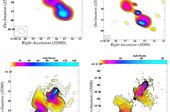
Identifying methods to discover dual active galactic nucleus (AGN) has proven to be challenging. Several indirect tracers have been explored in the literature, including X/S-shaped radio morphologies and double-peaked (DP) emission lines in the optical spectra. However, the detection rates of confirmed dual AGN candidates from the individual methods remain extremely small. We search for binary black holes (BBH) in a sample of six sources that exhibit both X-shaped radio morphology and DP emission lines using the Very Long Baseline Array (VLBA). Three out of the six sources show dual VLBA compact components, making them strong candidates for BBH sources. In addition, we present deep uGMRT images revealing the exquisite details of the X-shaped wings in three sources. We present a detailed precession modeling analysis of these sources. The black hole separations estimated from the simplistic geodetic precession model are incompatible with those estimated from emission line offsets and the VLBA separations. However, precession induced by a non-coplanar secondary black hole is a feasible mechanism for explaining the observed X-shaped radio morphologies and the black hole separations estimated from other methods. The black hole separations estimated from the double-peaked emission lines agree well with the VLBA compact component separations. Future multifrequency VLBA observations will be critical in ruling out or confirming the BBH scenario in the three galaxies with dual component detections.
 IIA INDRAJIT V. BARVE
A 1 bit Raw Voltage-recording System for Dedicated Observations of Transients at Low Radio Frequencies
Recently we had reported commissioning of a prototype for pulsar observations at low radio frequencies (<100 MHz) using log-periodic dipole antennas in the Gauribidanur Radio Observatory (≈77°E, 14°N) near Bangalore in India (https://www.iiap.res.in/?q=centers/radio). The aforementioned system (the Gauribidanur Pulsar System) is currently being augmented to directly digitize the radio-frequency signals from the individual antennas in the array. Our initial results using a 1 bit raw voltage-recording system indicate that such a back-end receiver offers distinct advantages like (i) simultaneous observations of any set of desired directions in the sky with multiple offline beams and smaller data rate/volume, and (ii) archival of the observed data with minimal resources for reanalysis in the future, either in the same or a different set of directions in the sky.
 IIA DIVAKAR, DEVIKA K
Possibilities of identifying members from Milky Way satellite galaxies using unsupervised machine learning algorithms
A detailed study of stellar populations in Milky Way (MW) satellite galaxies remains an observational challenge due to their faintness and fewer spectroscopically confirmed member stars. We use unsupervised machine learning methods to identify new members for nine nearby MW satellite galaxies using Gaia data release-3 (Gaia DR3) astrometry, the Dark Energy Survey (DES) and the DECam Local Volume Exploration Survey (DELVE) photometry. Two density-based clustering algorithms, DBSCAN and HDBSCAN, have been used in the four-dimensional astrometric parameter space (α2016, δ2016, μα cos δ, μδ) to identify member stars belonging to MW satellite galaxies. Our results indicate that we can recover more than 80% of the known spectroscopically confirmed members in most satellite galaxies and also reject 95–100% of spectroscopic nonmembers. We have also added many new members using this method. We compare our results with previous studies using photometric and astrometric data and discuss the suitability of density-based clustering methods for MW satellite galaxies.
 IIA WAGEESH MISHRA
CMEs evolve in the interplanetary medium to double their predicted geo-effectiveness
Context. We explore the impact of interactions between coronal mass ejections (CMEs) – known as CME–CME interactions – on Earth using remote-sensing and in situ observations and estimate the amplification of the geo-effectiveness of the individual CMEs by a factor of ∼2 due to CME–CME interactions.
Aims. We present 3D reconstructions of interacting CMEs, which provide essential information on the orientation and interaction of the events. Additionally, we analysed coronal evolution of CMEs and their in situ characteristics at 1 AU to explore the impact of interactions between CMEs on their geo-effectiveness.
Methods. We analysed CME interaction using white light data from LASCO and STEREO COR-A. The reported CMEs were reconstructed using the gradual cylindrical shell (GCS) model and simulated self-consistently with the physics-based 3D MHD model EUHFORIA (EUropean Heliosphere FORecasting Information Asset). By running different simulations, we estimated the geo-effectiveness of both individual and interacting CMEs using an empirical relationship method for the disturbance storm index.
Results. The SOHO/LASCO spacecraft observed three CMEs erupting from the Sun within an interval of 10 h during a very active period in early November 2021. There were two partial halo CMEs that occurred on 1 Nov. 2021 at 19:00 UT and 22:00 UT, respectively, from the active region 12887 (S28W58), and a third halo CME occurred from AR 12891 (N17E03) on 2 Nov. 2021 at 02:48 UT. By combining remote observations close to the Sun, in situ data at 1 AU, and further numerical analyses of each individual CME, we are able to identify the initial and interplanetary evolution of the CMEs.
Conclusions. (i) White light observations and a 3D reconstruction of the CMEs show cannibalism by CME-2 on CME-1 and a flank interaction of CME-3 with the merged CME-1 and CME-2 at 45–50 Rs. (ii) Interacting CMEs exhibit an increase in geo-effectiveness compared to an individual CME.
 IIA SRIRAM, S
First measurements of the airglow emissions from Kolhapur using an in-house developed Fabry–Perot interferometer
First-time airglow observations of the nighttime thermospheric wind from an in-house developed ground-based Fabry–Perot Interferometer are recorded from the Kolhapur location of India. This was the first attempt to build such an instrument, and thus the quality of the data recorded in the field is satisfactory. The instrument has been thoroughly calibrated in the laboratory, and the accuracy of the important parameter finesse of the etalon is found to be ≈94% in agreement with the value supplied by the manufacturer. The airglow observations from the field indicate that the vertical wind observed looking toward Zenith over the course of the night is zero, ensuring a 100% accuracy. However, the temperature measurements were found to be approximately 30% in agreement with the measurements repoted in literature. To improve this measurement, improvements in the optical design need to be made. The paper concludes with conclusions and a brief idea of the proposed improvisations in the design.
 IIA ARCHANA SOAM
Turbulence and magnetic fields in star formation
Molecular clouds are prime locations to study the process of star formation. These clouds contain filamentary structures and cores, which are crucial sites for the formation of young stars. The star-formation process has been investigated using various techniques, including polarimetry, for tracing magnetic fields. In this small review-cum-short report, we put together the efforts (mainly from the Indian community) to understand the roles of turbulence and magnetic fields in star formation. These are two components of the ISM competing against gravity, which is primarily responsible for the collapse of gas to form stars. We also include attempts made using simulations of molecular clouds to study this competition. Studies on feedback and magnetic fields are combined and listed to understand the importance of the interaction between two energies in setting the current observed star formation efficiency. We have listed available and upcoming facilities with the polarization capabilities needed to trace magnetic fields. We have also stated the importance of ongoing and desired collaborations between Indian communities and facilities abroad to shed more light on the roles of turbulence and magnetic fields in the process of star formation.
 IIA ANUPAMA, G. C
Science with the Daksha high energy transients mission
We present the science case for the proposed Daksha high energy transients mission. Daksha will comprise of two satellites covering the entire sky from 1 keV to > 1 MeV. The primary objectives of the mission are to discover and characterize electromagnetic counterparts to gravitational wave source; and to study Gamma Ray Bursts (GRBs). Daksha is a versatile all-sky monitor that can address a wide variety of science cases. With its broadband spectral response, high sensitivity, and continuous all-sky coverage, it will discover fainter and rarer sources than any other existing or proposed mission. Daksha can make key strides in GRB research with polarization studies, prompt soft spectroscopy, and fine time-resolved spectral studies. Daksha will provide continuous monitoring of X-ray pulsars. It will detect magnetar outbursts and high energy counterparts to Fast Radio Bursts. Using Earth occultation to measure source fluxes, the two satellites together will obtain daily flux measurements of bright hard X-ray sources including active galactic nuclei, X-ray binaries, and slow transients like Novae. Correlation studies between the two satellites can be used to probe primordial black holes through lensing. Daksha will have a set of detectors continuously pointing towards the Sun, providing excellent hard X-ray monitoring data. Closer to home, the high sensitivity and time resolution of Daksha can be leveraged for the characterization of Terrestrial Gamma-ray Flashes.
 IIA BHARAT CHANDRA, P
Spectroscopic Investigation of Nebular Gas (SING): instrument design, assembly and calibration
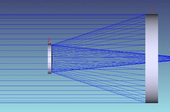
The Spectroscopic Investigation of Nebular Gas (SING) is a near-ultraviolet (NUV) low-resolution spectrograph payload designed to operate in the NUV range, 1400 Å – 2700 Å, from a stable space platform. SING telescope has a primary aperture of 298 mm, feeding the light to the long-slit UV spectrograph. SING has a field of view (FOV) of 1◦, achieving a spatial resolution of 1.33 arcminute and spectral resolution of 3.7 Å(R ∼ 600) at the central wavelength. SING employs a micro-channel plate (MCP) with a CMOS readout-based photon-counting detector. The instrument is designed to observe diffuse sources such as nebulae, supernova remnants, and the interstellar medium (ISM) to understand their chemistry. SING was selected by the United Nations Office for Outer Space Affairs to be hosted on the Chinese Space Station. The instrument will undergo qualification tests as per the launch requirements. In this paper, we describe the hardware design, optomechanical assembly, and calibration of the instrument.
 IIA HARSH MATHUR
Measurements of seeing-induced crosstalk in tip–tilt corrected solar polarimetry
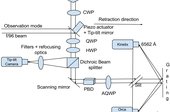
We present measurements of seeing-induced crosstalk using spectropolarimetric observations of sunspots recorded simultaneously in the H𝛼 and Ca ii 8662 Å lines with the Kodaikanal Tower Tunnel (KTT) telescope. The Kodaikanal Tower Tunnel telescope is integrated and installed with an image stabilization system consisting of a tip–tilt and an autoguider system. Additionally, the spectropolarimeter at KTT is upgraded to allow for the simultaneous recording of spectropolarimetric observations in three spectral lines. The tip–tilt system is shown to have a cutoff frequency of 80 Hz, effectively reducing the seeing induced crosstalk in the measured Stokes parameters by at least a factor of 2.