 SCOPE SCOPE
New computer model can help trace magnetic energy builds up & forecast impact of resulting CMEs
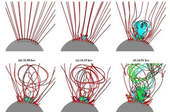
A multi-institutional team of scientists have developed a three-dimensional computer simulation model that can bring scientists a step closer to forecasting the arrival and impact of Coronal Mass Ejections (CMEs) before they reach Earth.
This study was published in the Astrophysical Journal in a paper titled "The Evolution of the Reconnection Flux during the Eruption of Magnetic Flux Ropes", and is authored by Samriddhi Sankar Maity (formerly IIA, currently at NASA and GSU USA), Piyali Chatterjee (IIA), Ranadeep Sarkar(Univ of Helsinki), and Ijas S. Mytheen (Eotvos Univ, Hungary).
The PIB press release is here.
The DST press release is here.
The paper is here.
 SCOPE SCOPE
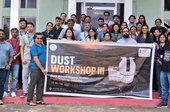
International Workshop on Cosmic Dust at Vainu Bappu Observatory, Kavalur
The Indian Institute of Astrophysics (IIA) is organising an international workshop on cosmic dust at its Vainu Bappu Observatory (VBO) located at Kavalur, Tamilnadu, from 11th to 14th August 2026. Over 50 participants are attending this workshop in person, most of whom are PhD scholars and postdoctoral fellows working in different institutes across India.
 SCOPE SCOPE
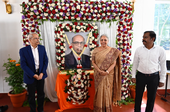
IIA Founders Day 2026 and Bappu Centenary Year
The Indian Institute of Astrophysics celebrated its 55th Founder's Day on 10th August 2026, on the birthday of its Founder-Director, Professor M.K. Vainu Bappu. This was a special occasion since this is the beginning of the centenary year celebrations of Prof. Bappu, who would have turned 100 on 10th August 2027. To honour Bappu’s scientific contributions, the institute organises the Founder’s Day lecture every year by renowned scientists from various fields. This year, the Founder's Day Lecture was delivered by Kris Gopalakrishnan, co-founder of Infosys and Chairperson, Axilor Ventures.
 SCOPE SCOPE
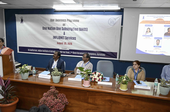
IIA Hosts ONOS User Awareness Programme in Collaboration with INFLIBNET Centre
The Indian Institute of Astrophysics (IIA), Bengaluru, through its Library, organised a User Awareness Programme on One Nation One Subscription (ONOS) and INFLIBNET Services on 5 August 2026 at the IIA campus in collaboration with the Information and Library Network (INFLIBNET) Centre, Gandhinagar. The programme aimed to create awareness about the ONOS initiative and promote effective utilisation of INFLIBNET’s digital resources and research support services among the academic and research community.
 SCOPE SCOPE
Celebrating 25 years of the Himalayan Chandra Telescope in Hanle
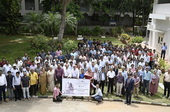
25 years of the successful operations of the 2-m Himalayan Chandra Telescope (HCT) atop Hanle in Ladakh was celebrated with a conference highlighting its history, engineering challenges, scientific research, and the road ahead.
The PIB press release is here.
The DST press release is here.
 SCOPE SCOPE
Astronomers discover an actively forming luminous blue straggler star
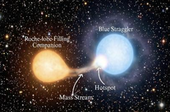
Indian astronomers, along with their international collaborators, have reported the rare discovery of a Blue Straggler Star (BSS) caught in the act of formation, providing direct evidence of how such stars are created.
This study was published in the Astrophysical Journal Letters in a paper titled "Blue Straggler in the Making: An X-Ray Active Binary in Algol Configuration", and is authored by A. H. Sheikh (IIT Guwahati), Biman J. Medhi (IIT Guwahati), Annapurni Subramaniam (IIA), Sergio Messina (INAF, Italy), Susmita Das (IUCAA), Hitendra Sarkar (IIT Guwahati), Anupam Bhardwaj (IUCAA), Atila Poro (Obs de Paris), Marina Kounkel (Univ of N. Florida, USA), and Ram Sagar (IIA).
The PIB press release is here.
The DST press release is here.
The paper is here.
 SCOPE SCOPE
High-resolution radio study reveals widespread faint black hole activity in nearby galaxies
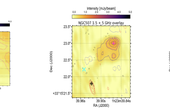
High-resolution radio investigations of nearby galaxies have revealed a hidden population of weakly active black holes in the local Universe that was so far difficult to detect.Hunting these hidden monsters is essential as they can inject energy into their surroundings through jets and outflows, influencing star formation rates and the long-term evolution of galaxies.
This study was published in the Monthly Notices of the Royal Astronomical Society in a paper titled "LeMMINGs VII: 5-GHz 50-mas e-MERLIN observations of a statistically complete sample of nearby AGNs", and is authored by DRA Williams-Baldwin et al, including Aru Beri (IIA).
The PIB press release is here.
The DST press release is here.
The paper is here.
 SCOPE SCOPE
Thermal signatures of three decades of solar storms at Earth reveal new clues for space weather forecasting
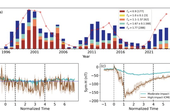
Indian astrophysicists have uncovered new insights into how large solar eruptions called Interplanetary Coronal Mass Ejections (ICMEs) evolve thermally during their journey from the Sun to the Earth, and how this thermal state influences their potential to disturb Earth’s magnetic environment that influence radio communications, aviation routes, and power grids.
This study was published in the Monthly Notices of the Royal Astronomical Society in a paper titled "Thermal properties of interplanetary coronal mass ejections at 1 au and their connection to geoeffectiveness across solar cycles 23–25", and is authored by Soumyaranjan Khuntia and Wageesh Mishra of IIA.
The PIB press release is here.
The DST press release is here.
The paper is here.
 SCOPE SCOPE
Astronomers find clues to the origin of energetic cosmic X-ray flashes
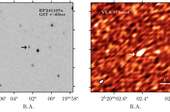
Astronomers have traced the mechanism behind a mysterious celestial non-repeating flash of X-ray called Fast X-ray Transients (FXTs) that was detected on November 7 last year. The study of the X-ray flash which they linked to collapse of a massive star or the merger of two neutron stars could help us better understand the physics of these extreme events.
This study was published in the Monthly Notices of the Royal Astronomical Society in a paper titled "Characterizing EP241107a: multiwavelength observations of an Einstein Probe-detected fast X-ray transient", and is authored by Deepak Eappachen, Arvind Balasubramanian, G. C. Anupama, D. K. Sahu and Sudhanshu Barway of the Indian Institute of Astrophysics, and Vishwajeet Swain, V. Bhalerao, Tanishk Mohan and G. Waratkar of the Indian Institute of Technology Bombay.
The PIB press release is here.
The DST press release is here.
The paper is here.
 SCOPE SCOPE
100 Years of slar data traces new clues on how the Suns surface tracks its 11-Year Activity Cycle
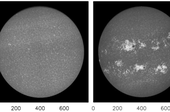
The Kodaikanal solar observatory, known for the oldest continuous series of solar data collected in India, have helped uncover how giant convection patterns on the Sun respond to solar activity, providing insights for future solar cycle prediction.
This study was published in the Astrophysical Journal Letters in a paper titled "Which Solar Latitude Follows the Sunspot Cycle Exactly?", and is authored by K.P. Raju of the Indian Institute of Astrophysics.
The PIB press release is here.
The DST press release is here.
The paper is here.