 IIA FIROZA SUTARIA
Transients and stellar activity as revealed by ultraviolet diagnostic tracers
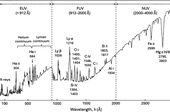
Ultraviolet (UV) observations offer unique insights into transient and variable astrophysical phenomena, from the Sun and nearby stars to supernovae and star-forming galaxies. Here, we summarise and review the diagnostic power of the UV spectrum for probing the physical conditions, dynamics and energetics of these events. We trace the historical development of UV astronomy from early satellite missions to the current landscape shaped by the Hubble Space Telescope, the GALaxy Evolution eXplorer, the Neil Gehrels Swift Observatory and AstroSat/UVIT. Particular emphasis is placed on resonance lines such as Mg II h and k, C II, Si IV, C IV and N V, which probe the (solar and) stellar chromosphere and transition region, revealing magnetic heating, shocks and mass loss across stellar types.We examine UV diagnostics of stellar flares, pre-main-sequence activity and rotation–activity correlations, linking them to exoplanetary irradiation and habitability. We then explore the UV view of supernova shock breakout and early-time emission, as well as the far-UV mapping of young stellar populations and hierarchical star formation in the Magellanic Clouds. Together, these aspects illustrate how the UV connects small-scale plasma processes to galactic-scale star formation. Despite remarkable progress, UV transient astronomy remains limited by instrument availability and cadence. Forthcoming missions promise to transform this field by capturing the rapid, luminous phenomena that define the dynamic Universe.
 IIA MRIDWEEKA SINGH
Wild behaviour near the finish line: The Type Ibn SN 2020able and its stratified environment
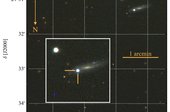
We present spectrophotometric observations of the Type Ibn supernova SN 2020able, along with a comprehensive analysis and modelling of its evolution. The transient occurred in SDSS J092602.93+243115.1, a faint host galaxy characterised by significantly subsolar metallicity (12 + log(O/H) ≃ 8.28 dex). The early photometric evolution and high peak luminosity (Lpeak ≃ 4.4 × 1043 erg s−1) indicate an efficient conversion of ejecta kinetic energy into radiation via interaction with the circumstellar medium. Light-curve modelling suggests that this interaction involves ejecta with a mass of Mej ≃ 1.3 M☉ impacting a shell of MCSM ≃ 0.6 M☉. However, interaction is found to be geometrically and temporally confined within a few days after explosion, with the later evolution of the transient being dominated by the free expansion of the ejecta. Spectroscopic analysis reveals a complex, stratified, circumstellar environment. In addition to the innermost shocked region, we identify two additional He-rich shells: a dense inner one (ne ≃ 1.4 × 109 cm−3) located at R ≳ 9.3 × 1014 cm, and a more extended outer component reaching Rout ≃ 3.3 × 1015 cm and expanding at approximately 1.2 × 10³ km s−1. The physical parameters of the former suggest it was produced by a discrete, pre-supernova eruptive event similar to that of SN 2006jc, which expelled approximately 1.8 × 10⁻² M☉ of material. Conversely, the expansion velocity of the outermost shell is consistent with the escape velocity of Wolf–Rayet stars, pointing towards a late WN- to WC-type progenitor as the most viable candidate for SN 2020able.
 IIA ANJALI AGARWAL
Coordinated coronagraphic observations from Proba-3 and Aditya-L1: Investigating coronal mass ejection energetics in the inner corona
Context. Constraining the plasma properties and energetics of coronal mass ejections (CMEs) in the inner corona is essential for understanding their early evolution, yet it remains challenging because of limited observations.
Aims. We investigate the mass and density evolution as well as energy partitioning of two CMEs observed on 14 and 16 September 2025, and assess the potential of coordinated Proba-3/ASPIICS and Aditya-L1/VELC observations to constrain CME energetics in the low corona.
Methods. We present the first coordinated observations of CMEs obtained simultaneously by Proba-3/ASPIICS and Aditya-L1/VELC. Using ASPIICS white-light observations, we estimated the CME mass, volume, number density, and the evolution of kinetic, thermal, and magnetic energies. Magnetic energies were estimated from observed CME properties using observationally constrained, physically motivated assumptions. Simultaneous VELC Fe XIV 5303 A observations provide independent estimates of the emission measure, electron number density, thermal energy, and CME lateral extent.
Results. The electron number density evolves as neχ r-33 for the 14 September CME and as ne ∝ r−6 for the 16 September CME. The two events exhibit markedly different energy partitioning in the low corona. For the 14 September CME, the kinetic and magnetic energies are comparable, while the thermal energy remains nearly two orders of magnitude smaller, indicating limited plasma heating. In contrast, the 16 September CME exhibits a substantial thermal-energy enhancement, with thermal energy eventually becoming comparable to kinetic energy. For both CMEs, the estimated magnetic energy remains comparable to or exceeds the kinetic energy over the observed height.
Conclusions. Our results demonstrate the scientific potential of synergetic ASPIICS and VELC observations for constraining the CME mass, density, and energetics in the inner corona, providing new observational constraints on the early evolution of CMEs.
 IIA VIVEK, M
SDSS-V BHM: Evidence for a link between X-ray weakness and galaxy-scale ionised gas outflows in quasars
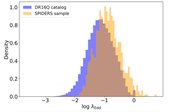
Active galactic nuclei (AGNs) are among the most powerful engines in the Universe. A central open question is how accretion physics, obscuration, and feedback are intertwined in shaping these systems. This paper presents an analysis of SDSS-V–eROSITA Data Level 1 (DL1) data from the 19th data release (DR19). The work is based on SDSS spectra for 2119 soft X-ray selected quasars (0 < z < 0.95), drawn from the eROSITA all-sky catalogue (eRASS1), and complemented by mid-infrared (MIR) data from the Wide-field Infrared Survey Explorer (WISE). We assessed the outflow strength using the W80 measurement of the [OIII] λ5007 emission line and derived the virial black hole mass from the broad Hβ emission line. The rest-frame 2–10 keV X-ray luminosity and the 6 μm MIR luminosity were used to determine the X-ray weakness, relative to established luminosity scaling relations. We compared the W80line width, X-ray luminosity, and black hole mass and report a weak negative trend between X-ray weakness and outflow strength for quasars with W80 ≥ 800 km s−1. These results support the interpretation that the observed X-ray weakness in AGNs may be linked to dense, nuclear-scale outflows.
 IIA DEVANG AGNIHOTRI
1.5D investigation of the Hanle effect in the Ca I 4227 line using partial frequency redistribution
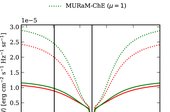
Context. Modeling scattering polarization in the Ca I 4227 Å line is important for diagnosing chromospheric magnetic fields. This requires solving the polarized radiative transfer equation, including the Hanle effect and partial frequency redistribution (PFR). Planeparallel, semi-empirical models are known to be inadequate for accurately reproducing the observed scattering polarization profiles of this line Aims. The primary aim of this work is to investigate the relative influence of heights of formation and magnetic fields (via the Hanle effect) in realistic solar model atmospheres on the emergent spatially averaged synthetic Stokes profiles of the Ca I 4227 Å line. Methods. For this purpose, we used 1D vertical columns derived from snapshots of recent 3D radiative magnetohydrodynamic (rMHD) simulations of the solar chromosphere performed with the Bifrost and MURaM-ChE codes as model atmospheres. We then carried out 1.5D nonlocal thermodynamic equilibrium (NLTE) polarized radiative transfer calculations, including the PFR and the Hanle effect. Results. The intensity profiles from both simulations coincide at the line core, whereas the line wings in MURaM-ChE display a higher intensity as these signals originate from deeper, hotter regions. The polarization signals are formed at greater heights in MURaM-ChE than in Bifrost. In the nonmagnetic case, the emergent, spatially averaged profiles from Bifrost exhibit a larger polarization amplitude in the line core, whereas MURaM-ChE ones show enhanced polarization in the wings. When the impact of magnetic fields from the 3D rMHD simulations is included, the spatially averaged profiles indicate stronger Hanle depolarization of ⟨Q⟩/⟨I⟩ in the Bifrost snapshot. Conclusions. Because scattering polarization is highly sensitive to the heights at which the polarization signals are formed, the differing thermal and magnetic structures at the corresponding line formation heights in the two simulations lead to distinct Stokes profiles. In particular, the Hanle depolarization signatures indicate that the line-core formation region in the MURaM-ChE snapshot is less strongly magnetized compared to the Bifrost snapshot.
 IIA STALIN, C. S
A gamma-ray-emitting head-tail radio galaxy swimming through the hot medium of the merging cluster A3627
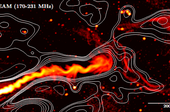
Head–tail radio sources are jetted active galactic nuclei (AGN) moving through the dense intracluster medium of galaxy clusters. They are extremely rare in the γ-ray sky, likely because they are usually observed at large viewing angles. Therefore, every new γ-ray detection of head–tail radio galaxies allows us to probe the origin of the highenergy emission in this unique class of AGN. Here we report, for the first time, the association of ESO 0137−G007 (z = 0.016), a head–tail radio galaxy located at the outskirts of the merging cluster A3627, with the γ-ray source FL16Y J1615.5−6034. The motion of the galaxy through the dense cluster environment and subsequent ram pressure and/or intracluster medium turbulence have led to the formation of a >500 kpc long jet exhibiting a twisted, wiggly radio morphology. Its optical spectrum, obtained with the 4.1 m SOAR telescope, is devoid of emission lines, indicating that the underlying accretion activity is radiatively inefficient. From the measured line-of-sight stellar velocity dispersion, we estimate the mass of the central supermassive black hole to be (3.36 ± 1.32) × 10^9 M⊙. We briefly discuss several radiative models to explain the observed broadband spectral energy distribution of ESO 0137 −G007. We conclude that deeper multiwavelength observations of this unique γ-ray-emitting head–tail radio galaxy will enable us to better understand the interaction of the jet with the hot cluster environment, thus setting the stage for the research of this class of AGN with the upcoming Square Kilometre Array.
 IIA SAHU, D. K
Two years of shock interaction tracing three phases of evolution: The explosion of a type IIn supernova, SN 2019vxm
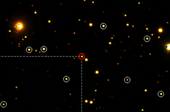
We present multiwavelength photometric and optical spectroscopic observations of the long-lived interacting supernova SN 2019vxm, spanning more than 2 yr after the explosion. SN 2019vxm is a slowly rising (rise time ∼ 43 days in the R-band), slowly declining supernova reaching an R-band peak absolute magnitude of ≈−20.3 mag. The SN light curve postmaximum shows a shallow decline, followed by a secondary, steeper decline in the optical (∼0.01 mag day−1), with late-time IR brightening. The total radiated luminosity is 5 × 10^50 erg, placing it among the energetic class of its type. We estimated a CSM mass of 3–8 M⊙ through light-curve modeling (independent of the CSM density profile) and by comparison with theoretical models. We estimate a minimum ejecta mass of ∼3.88 M⊙ from the broad Hα component, consistent with the ejecta mass obtained from the light-curve models. The solely interaction-dominated initial epochs are later accompanied by photonscattering signatures, leading to asymmetric line profiles with symmetric wings. The late phase, characterized by enhanced brightness at longer wavelengths and a stronger asymmetric line profile with the red side flux strongly suppressed, indicates the influence of preexisting or newly formed dust with temperatures ∼1600 K at ∼4 × 10^16 cm. Even in the late phases, no nebular lines are present in the spectra, indicating dense or obscured ejecta.
 IIA RAJAGURU, S. P
Nonzero phase shift of evanescent acoustic waves in the lower solar atmosphere
Context. The phase behavior of acoustic waves in the lower solar atmosphere provides important information about wave propagation. While previous studies have reported nonzero phase shifts in the evanescent frequency range and possible sign reversals near the frequency 3.0 mHz, the observational robustness and physical interpretation of these signatures remain uncertain.
Aims. We investigated the phase shifts and travel times of acoustic waves within the photosphere and across the photosphere-chromosphere interface in the quiet-Sun atmosphere and also assessed their height and frequency-dependent behavior.
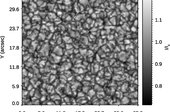
Methods. Multi-height line-of-sight velocities were inferred using the bisector method applied to the photospheric Fe I 6173 Å and chromospheric Hα 6563 Å spectral lines observed with the Swedish Solar Telescope (SST). Fast Fourier transform analysis was employed to determine the phase shifts and travel times between the velocity signals derived at different bisector levels. In addition, k–ω phase-difference diagnostics were used to examine the wave number and frequency-dependent characteristics of wave propagation.
Results. Nonzero phase shifts are detected for acoustic waves in the evanescent frequency range within the photosphere, corresponding to phase travel times on the order of 1 s. In contrast to previous studies, no reversal in the sign of the phase shift or travel time is observed near 3 mHz in the Fe I 6173 Å observations. The measured phase shifts maintain the same sign throughout the investigated frequency range, suggesting the influence of complex wave dynamics. Measurements between velocities inferred from the Fe I and Hα lines exhibit a decrease in the 6–8 mHz frequency range. Our k–ω phase-difference analysis shows that this behavior is mainly caused by phase wrapping near 6.5 mHz rather than by an intrinsic change in wave propagation.
Conclusions. Our findings support the presence of nonzero phase differences within the evanescent frequency range while revealing discrepancies with earlier reports of phase-shift sign reversals near 3 mHz. We also highlight the importance of proper phase unwrapping for an accurate interpretation of acoustic-wave propagation in the lower solar atmosphere.
 IIA KAJOL PAITHANKAR
Time delay as a probe of multiple photon spheres
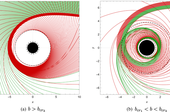
Black hole shadow images are primarily determined by the properties of photon spheres and can exhibit degeneracies across different spherically symmetric spacetime geometries. We show that time delay observables associated with higher-order images of transient sources provide a robust probe to break such degeneracies in spacetimes admitting multiple photon spheres. Adopting a theory-agnostic, parametrized, static, spherically symmetric framework that captures the generic features of double-peak effective potentials, we investigate photon geodesics and quantify them in terms of angular deflection, travel time, and the order of the image. We identify distinctive signatures of trajectories probing the region between the unstable photon spheres. In particular, we find that these trajectories are characterized by the nontrivial temporal behavior, including a minimum travel time, a minimum angular deflection, and a characteristic triplet structure of higher-order images with a specific arrival sequence. We further show that the influence of the depth of the potential well, between the two photon spheres, on the observed time delays provides a direct handle on otherwise inaccessible regions of the spacetime. Although we consider a parametrized framework, these identified signatures are primarily influenced by the potential structure and will therefore occur in any spacetime with a similar double-peak effective potential. Our results highlight that timedomain lensing observables encode information beyond static shadow images and offer a promising avenue for probing the structure of compact objects and the strong-field regime of gravity.
 IIA AVIJIT CHOWDHURY
Ringdown and tide: fingerprints of dark matter halo profiles
Astrophysical black holes (BHs) are not isolated, but embedded in matter supplied by their host galaxies. We study how the shape of a surrounding dark matter halo modifies the ringdown and tidal response of an asymptotically flat, static, spherically symmetric BH. The halo is modeled as an anisotropic Einstein cluster with vanishing radial pressure and a generalized (α,β,γ) density profile, supplemented by an inner cutoff near the BH and, where required, an outer tidal truncation. We derive the axial gravitational perturbation equation and compute the quasinormal mode (QNM) spectrum using sixth-order Wentzel-Kramers-Brillouin (WKB) methods and time-domain evolutions. The halo redshifts both the oscillation frequency and the damping rate, by an amount set not only by the halo compactness but also by the profile parameters: the inner logarithmic slope γ dominates for centrally concentrated halos, while α and β give subleading but profile-dependent corrections. In the eikonal limit, the shift is governed by a single redshift integral encoding the halo mass distribution outside the light ring, explaining the close correspondence between the QNM frequencies, the light ring frequency, and the Lyapunov exponent. We also show that different combinations of compactness and profile shape can yield nearly degenerate ringdown spectra. Time-domain evolutions confirm the WKB frequencies and display the expected late-time Price-law decay, with an intermediate tail controlled by the outer density falloff for slowly decaying profiles. Finally, we compute the static axial tidal Love number and show that it probes the halo with a radial weighting different from the ringdown sector. The combined ringdown and tidal response therefore provides a possible way to distinguish environmental effects from genuine deviations of the vacuum BH geometry.