 IIA WAGEESH MISHRA
Low-latitude Auroras: Insights from 2023 April 23 Solar Storm
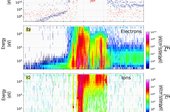
In 2023 April, a low-latitude aurora observed by the all-sky camera at Hanle, Ladakh, India (33°14'N geographic latitude), generated significant interest. This was the first such aurora recorded from the Indian region in the space era and occurred during a moderate solar storm. This study explores this low-latitude auroral sighting, which happened during the sheath-region passage of an interplanetary coronal mass ejection. We analyze in situ multispacecraft particle measurements and geomagnetic field observations from both ground-based and satellite-based magnetometers. The auroral observations at Hanle coincided with intense substorm activity. Our findings indicate that the aurora did not actually reach India; the equatorward boundary was beyond 50°N geographic latitude. Enhanced electron fluxes with energies below 100 eV were detected at 54°N geographic latitude at about 830 km altitude in the predawn sector (4–5 hr local time). In the midnight sector, the equatorward boundary is estimated to be around 52°N geographic latitude, based on Hanle observations and considering emission altitudes of 600–650 km due to low-energy electrons. Thus, the low-latitude red aurora observed from India resulted from the emissions at higher altitudes due to low-energy electron precipitation in the auroral oval and a slight equatorward expansion of the auroral oval. The low-energy electrons likely originated from the plasma sheet and were precipitated due to enhanced wave–particle interactions from strong magnetosphere compression during high solar wind pressure. This study is crucial in understanding low-latitude auroras in the modern space era.
 IIA MRIDWEEKA SINGH
CSS 161010: A luminous fast blue optical transient with broad blueshifted hydrogen lines
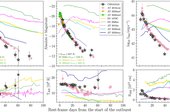
We present ultraviolet, optical, and near-infrared photometric and optical spectroscopic observations of the luminous fast blue optical transient (LFBOT) CSS 161010:045834–081803 (CSS 161010). The transient was found in a low-redshift (z = 0.033) dwarf galaxy. The light curves of CSS 161010 are characterized by an extremely fast evolution and blue colors. The V-band light curve shows that CSS 161010 reaches an absolute peak of mag in 3.8 days from the start of the outburst. After maximum, CSS 161010 follows a power-law decline ∝t ‑2.8±0.1 in all optical bands. These photometric properties are comparable to those of well-observed LFBOTs such as AT 2018cow, AT 2020mrf, and AT 2020xnd. However, unlike these objects, the spectra of CSS 161010 show a remarkable transformation from a blue and featureless continuum to spectra dominated by very broad, entirely blueshifted hydrogen emission lines with velocities of up to 10% of the speed of light. The persistent blueshifted emission and the lack of any emission at the rest wavelength of CSS 161010 are unique features not seen in any transient before CSS 161010. The combined observational properties of CSS 161010 and its M * ∼ 108 M ⊙ dwarf galaxy host favor the tidal disruption of a star by an intermediate-mass black hole as its origin.
 IIA TANMOY SAMANTA
Transition region brightening in a moss region and their relation with lower atmospheric dynamics
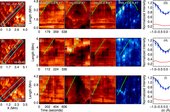
Small-scale brightenings (SBs) are commonly observed in the transition region (TR) that separates the solar chromosphere from the corona. These brightenings, omnipresent in active region patches known as "moss" regions, could potentially contribute to the heating of active region plasma. In this study, we investigate the properties of SB events in a moss region and their associated chromospheric dynamics, which could provide insights into the underlying generation mechanisms of the SBs. We analyzed the data sets obtained by coordinated observations using the Interface Region Imaging Spectrograph and the Goode Solar Telescope at Big Bear Solar Observatory. We studied 131 SB events in our region of interest and found that 100 showed spatial and temporal matches with the dynamics observed in the chromospheric Hα images. Among these SBs, 98 of them were associated with spicules that are observed in Hα images. Furthermore, detailed analysis revealed that one intense SB event corresponded to an Ellerman bomb (EB), while another SB event consisted of several recurring brightenings caused by a stream of falling plasma. We observed that Hα far wings often showed flashes of strong brightening caused by the falling plasma, creating an Hα spectral profile similar to an EB. However, 31 of the 131 investigated SB events showed no noticeable spatial and temporal matches with any apparent features in Hα images. Our analysis indicated that the predominant TR SB events in moss regions are associated with chromospheric phenomena primarily caused by spicules. Most of these spicules display properties akin to dynamic fibrils.
 IIA ARCHANA SOAM
The JCMT BISTRO survey: The magnetic fields of the IC 348 star-forming region
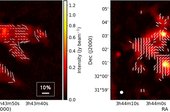
We present 850 μm polarization observations of the IC 348 star-forming region in the Perseus molecular cloud as part of the B-fields In STar-forming Region Observation survey. We study the magnetic properties of two cores (HH 211 MMS and IC 348 MMS) and a filamentary structure of IC 348. We find that the overall field tends to be more perpendicular than parallel to the filamentary structure of the region. The polarization fraction decreases with intensity, and we estimate the trend by power law and the mean of the Rice distribution fittings. The power indices for the cores are much smaller than 1, indicative of possible grain growth to micron size in the cores. We also measure the magnetic field strengths of the two cores and the filamentary area separately by applying the Davis–Chandrasekhar–Fermi method and its alternative version for compressed medium. The estimated mass-to-flux ratios are 0.45–2.20 and 0.63–2.76 for HH 211 MMS and IC 348 MMS, respectively, while the ratios for the filament are 0.33–1.50. This result may suggest that the transition from subcritical to supercritical conditions occurs at the core scale (∼0.05 pc) in the region. In addition, we study the energy balance of the cores and find that the relative strength of turbulence to the magnetic field tends to be stronger for IC 348 MMS than for HH 211 MMS. The result could potentially explain the different configurations inside the two cores: a single protostellar system in HH 211 MMS and multiple protostars in IC 348 MMS
 IIA RAVI JOSHI
Star formation in neutral hydrogen gas reservoirs at cosmic noon
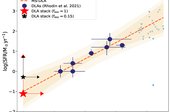
We aim to constrain the average star formation associated with neutral hydrogen gas reservoirs at cosmic noon. We used a unprecedented sample of 1716 high-column-density, damped Ly-α absorbers (DLAs) from the Sloan Digital Sky Survey with log(N(H I)/cm‑2) ≥ 21. This allowed us to generate the average Ly-α emission spectrum associated to DLAs, free from any emission coming from the background quasar. We measured the Lyα emission at > 5.8σ level with a luminosity of 8.95 ± 1.54 × 1040 erg s‑1 (corresponding to about 0.02 L⋆ at z ∼ 2 ‑ 3) in systems with average log(N(H I) /cm‑2) of ≈21.2 and at a median redshift of z ∼ 2.64. The peak of the Lyα emission is apparently redshifted by ∼300 km s‑1 relative to the absorption redshift, which appears to be due to suppression of blue Ly-α photons by radiative transfer through expanding gas. We infer that DLAs form stars with an average rate of (0.08 ± 0.01)/fescM⊙ yr‑1; namely, ≈ (0.54 ± 0.09) M⊙ yr‑1 for a typical escape fraction (fesc = 0.15) of Lyman-α emitting galaxies. DLA galaxies follow the main sequence of star-forming galaxies at high redshift, suggesting that the DLA population is dominated by the lower mass end of Lyman-α emitting galaxies.
 IIA M. SINGH
AT 2021hdr: A candidate tidal disruption of a gas cloud by a binary super massive black hole system
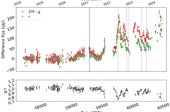
With a growing number of facilities able to monitor the entire sky and produce light curves with a cadence of days, in recent years there has been an increased rate of detection of sources whose variability deviates from standard behavior, revealing a variety of exotic nuclear transients. The aim of the present study is to disentangle the nature of the transient AT 2021hdr, whose optical light curve used to be consistent with a classic Seyfert 1 nucleus, which was also confirmed by its optical spectrum and high-energy properties. From late 2021, AT 2021hdr started to present sudden brightening episodes in the form of oscillating peaks in the Zwicky Transient Facility (ZTF) alert stream, and the same shape is observed in X-rays and UV from Swift data. The oscillations occur every ∼60–90 days with amplitudes of ∼0.2 mag in the g and r bands. Very Long Baseline Array (VLBA) observations show no radio emission at milliarcseconds scale. It is argued that these findings are inconsistent with a standard tidal disruption event (TDE), a binary supermassive black hole (BSMBH), or a changing-look active galactic nucleus (AGN); neither does this object resemble previous observed AGN flares, and disk or jet instabilities are an unlikely scenario. Here, we propose that the behavior of AT 2021hdr might be due to the tidal disruption of a gas cloud by a BSMBH. In this scenario, we estimate that the putative binary has a separation of ∼0.83 mpc and would merge in ∼7 × 10⁴ years. This galaxy is located at 9 kpc from a companion galaxy, and in this work we report this merger for the first time. The oscillations are not related to the companion galaxy.
 IIA SIPRA HOTA
UVIT study of the MAgellanic clouds (U-SMAC). II. a far-uv catalog of the small magellanic cloud: morphology and kinematics of young stellar population
The Small Magellanic Cloud (SMC) is an irregular dwarf galaxy that has recently undergone an interaction with the Large Magellanic Cloud. The young massive stars in the SMC formed in the disturbed low-metallicity environment are important targets in astrophysics. We present a catalog of ∼76,800 far-ultraviolet (FUV) sources toward the SMC detected using the Ultra Violet Imaging Telescope onboard AstroSat. We created an FUV catalog with ∼62,900 probable SMC members which predominantly comprise main-sequence, giant, and subgiant stars. We selected four young populations (Young 1, Young 2, Young 3, and Blue Loop (BL) stars) identified from the Gaia optical color–magnitude diagram to study the morphology and kinematics of the young SMC using this catalog. We detect a clumpy morphology with a broken bar, a shell-like structure, and the inner SMC Wing for the four stellar populations. The eastern region and the northeastern regions are mainly populated by Young 1, 2, and 3 stars. The central region predominantly has the Young 2 and 3 populations, whereas the SW has BL stars, and Young 2 and 3 stars. The 2D kinematic study using proper motion (PM) reveals that Young 2 and 3 populations show two kinematically distinct subpopulations with low and high PM dispersion, whereas the Young 1 and BL stars show two kinematically distinct populations with low dispersion. Our analysis points to a kinematic disturbance along the R.A. direction for stars younger than ∼150 Myr located in the eastern region, with no significant disturbance along the decl.
 IIA RAVEENA KHAN
Design requirements of a spectropolarimeter for solar extreme-ultraviolet observations and characterization of a K-mirror based on Brewster's angle
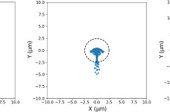
Measuring the linear polarization signal in extreme-ultraviolet (EUV) spectral lines, produced by the Hanle effect, offers a promising technique for studying magnetic fields in the solar corona. The required signal-to-noise ratio for detecting the Hanle polarization signals is on the order of 101 (off-limb) to 106 (disk center). Measuring such low signals in the photon starved observations demands highly efficient instruments. In this paper, we present the design of an instrument, SpectroPOLarimeter for Extreme-ultraviolet Observations (SPOLEO), which utilizes reflective components with suitable mirror coatings and thicknesses to minimize the throughput losses. We analyze the system performance within the spectral range from 740 to 800 Å. The K-mirror-based polarimeter model provides a polarizing power of 20%–40% in this wavelength range. Based on the system throughput and polarizing power, we discuss various possibilities for achieving the required signal-to-noise ratio, along with their limitations. Due to lack of facilities for fabrication and testing in the EUV, we have calibrated a prototype of the reflection-based polarimeter setup in the laboratory at the visible wavelength of 700 nm.
 IIA ARCHANA SOAM
Applying the velocity gradient technique in NGC 1333: comparison with dust polarization observations
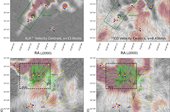
Magnetic fields (B-fields) are ubiquitous in the interstellar medium (ISM), and they play an essential role in the formation of molecular clouds and subsequent star formation. However, B-fields in interstellar environments remain challenging to measure, and their properties typically need to be inferred from dust polarization observations over multiple physical scales. In this work, we seek to use a recently proposed approach called the velocity gradient technique (VGT) to study B-fields in star-forming regions and compare the results with dust polarization observations in different wavelengths. The VGT is based on the anisotropic properties of eddies in magnetized turbulence to derive B-field properties in the ISM. We investigate that this technique is synergistic with dust polarimetry when applied to a turbulent diffused medium for the purpose of measuring its magnetization. Specifically, we use the VGT on molecular line data toward the NGC 1333 star-forming region (12CO, 13CO, C18O, and N2H+), and we compare the derived B-field properties with those inferred from 214 and 850 μm dust polarization observations of the region using Stratospheric Observatory for Infrared Astronomy/High-Resolution Airborne Wide-band Camera Plus and James Clerk Maxwell Telescope/POL-2, respectively. We estimate both the inclination angle and the 3D Alfvénic Mach number M A from the molecular line gradients. Crucially, testing this technique on gravitationally bound, dynamic, and turbulent regions, and comparing the results with those obtained from polarization observations at different wavelengths, such as the plane-of-sky field orientation, is an important test on the applicability of the VGT in various density regimes of the ISM. We in general do not find a close correlation between the velocity gradient inferred orientations and the dust inferred magnetic field orientations.
 IIA SHARANYA SUR
Probing the morphology of polarized emission induced by fluctuation dynamo using minkowski functionals
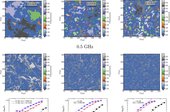
The morphology and the characteristic scale of polarized structures provide crucial insights into the mechanisms that drive turbulence and maintain magnetic fields in magneto-ionic plasma. We aim to establish the efficacy of Minkowski functionals as quantitative statistical probes of filamentary morphology of polarized synchrotron emission resulting from fluctuation dynamo action. Using synthetic observations generated from magnetohydrodynamic simulations of fluctuation dynamos with varying driving scales (ℓ f) of turbulence in isothermal, incompressible, and subsonic media, we study the relation between different morphological measures and their connection to fractional polarization (p f). We find that Faraday depolarization at low frequencies gives rise to small-scale polarized structures that have higher filamentarity as compared to the intrinsic structures that are comparable to ℓ f. Above ∼3 GHz, the number of connected polarized structures per unit area (N CC,peak) is related to the mean p f (<p f>) of the emitting region as <pf>∝NCC,peak‑1/4 , provided the scale of the detectable emitting region is larger than ℓ f. This implies that N CC,peak represents the number of turbulent cells projected on the plane of the sky and can be directly used to infer ℓ f via the relation ℓf∝NCC,peak‑1/2 . An estimate of ℓ f thus directly allows for pinning down the turbulence-driving mechanism in astrophysical systems. While the simulated conditions are mostly prevalent in the intracluster medium of galaxy clusters, the qualitative morphological features are also applicable in the context of interstellar medium in galaxies.