 IIA STALIN, C. S
Spectrophotometric reverberation mapping of intermediate-mass black hole NGC 4395
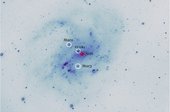
Understanding the origins of massive black hole seeds and their coevolution with their host galaxy requires studying intermediate-mass black holes (IMBHs) and estimating their mass. However, measuring the masses of these IMBHs is challenging, due to the high-spatial-resolution requirement. Spectrophotometric reverberation monitoring is performed for a low-luminosity Seyfert 1 galaxy, NGC 4395, to measure the size of the broad-line region and black hole mass. The data were collected using the 1.3 m Devasthal fast optical telescope and 3.6 m Devasthal optical telescope at ARIES, Nainital, over two consecutive days in 2022 March. The analysis revealed strong emission lines in the spectra and light curves of the merged 5100 Å spectroscopic continuum flux (f 5100) with the photometric continuum V band and Hα, with fractional variabilities of 6.38% and 6.31% respectively. In comparison to several previous studies with lag estimation <90 minutes, our calculated Hα lag supersedes them by minutes, using the ICCF and JAVELIN methods. The velocity dispersion (σ line) of the broad-line clouds is measured to be km s‑1, yielding a black hole mass of ∼ and an Eddington ratio of 0.06.
 IIA STALIN, C. S
Radio morphology of gamma-ray sources: Double-lobed radio sources
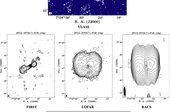
The extragalactic γ-ray sky is dominated by relativistic jets aligned to the observer's line of sight, i.e., blazars. A few of their misaligned counterparts, e.g., radio galaxies, are also detected with the Fermi-Large Area Telescope (LAT), albeit in a small number (∼50), indicating the crucial role played by the jet viewing angle in detecting γ-ray emission from jets. These γ-ray emitting misaligned active galactic nuclei (AGN) provide us with a unique opportunity to understand the high-energy emission production mechanisms from a different viewpoint than the more common blazars. With this goal in mind, we have systematically studied the radio morphology of γ-ray emitting sources present in the fourth data release of the fourth catalog of Fermi-LAT detected γ-ray sources to identify misaligned AGN. By utilizing the high-resolution and sensitive MHz and GHz frequency observations delivered by the Very Large Array Sky Survey, Low-Frequency Array Two-metre Sky Survey, Faint Images of the Radio Sky at Twenty Centimeters, and Rapid ASKAP Continuum Survey, here we present a catalog of 149 γ-ray detected misaligned AGN, thus approximately tripling the number of known objects of this class. Our sample includes a variety of radio morphologies, e.g., edge-darkened and edge-brightened, hybrids, wide-angle-tailed, bent jets, and giants. Since the γ-ray emission is thought to be highly sensitive to the jet viewing angle, such an enlarged sample of γ-ray detected misaligned radio sources will permit us to explore the origin of high-energy emission in relativistic jets and radio lobes and study AGN unification, in general.
 IIA ARUN MANGALAM
GC 7314: X-ray study of the evolving accretion properties
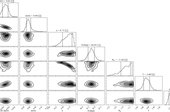
We present a comprehensive analysis of the timing and spectral properties of NGC 7314, a Seyfert 1.9 galaxy, using X-ray observations from XMM-Newton, NuSTAR, and RXTE/proportional counter array (PCA). The timing analysis reveals significant variability across different energy bands, with fractional variability values consistent with previous studies. The highly variable soft photons and comparatively less variable high-energy photons imply different origins of these two types. The soft energy photons come from a hot corona near the center, while the high-energy photons are produced by inverse Compton scattering of these primary X-ray photons in a hot plasma away from the central region. The spectral analysis employs various models to characterize the emission components. The results indicate the presence of a soft energy bump, Fe Kα line emission, and a prominent reflection component. The long-term RXTE/PCA data analysis reveals temporal variations in the photon index (Γ) and power-law flux, suggesting evolving emission properties over time. The signature of both broad and narrow Fe Kα emission line features suggested the broad, variable one coming from the accretion disk (∼10‑5 pc), while the nonevolving narrow line cannot be well constrained. The absorption feature could originate in a highly ionized region, possibly closer to the broad-line region. The evolution of the inner accretion properties indicates that NGC 7314 could be a potential changing-state active galactic nucleus.
 IIA WAGEESH MISHRA
Study of evolution and geo-effectiveness of coronal mass ejection–coronal mass ejection interactions using magnetohydrodynamic simulations with SWASTi framework
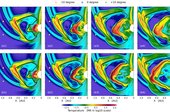
The geo-effectiveness of coronal mass ejections (CMEs) is a critical area of study in space weather, particularly in the lesser-explored domain of CME–CME interactions and their geomagnetic consequences. This study leverages the Space Weather Adaptive SimulaTion framework to perform 3D MHD simulation of a range of CME–CME interaction scenarios within realistic solar wind conditions. The focus is on the dynamics of the initial magnetic flux, speed, density, and tilt of CMEs, and their individual and combined impacts on the disturbance storm time (Dst) index. Additionally, the kinematic, magnetic, and structural impacts on the leading CME, as well as the mixing of both CMEs, are analyzed. Time-series in situ studies are conducted through virtual spacecraft positioned along three different longitudes at 1 au. Our findings reveal that CME–CME interactions are nonuniform along different longitudes, due to the inhomogeneous ambient solar wind conditions. A significant increase in the momentum and kinetic energy of the leading CME is observed due to collisions with the trailing CME, along with the formation of reverse shocks in cases of strong interaction. These reverse shocks lead to complex wave patterns inside CME2, which can prolong the storm recovery phase. Furthermore, we observe that the minimum Dst value decreases with an increase in the initial density, tilt, and speed of the trailing CME.
 IIA STALIN, C. S
On the properties of X-Ray corona in Seyfert 1 galaxies
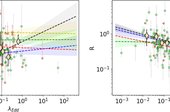
We carried out a uniform and systematic analysis of a sample of 112 nearby bright Seyfert 1 type active galactic nuclei, the observations of which were carried out by the Nuclear Spectroscopic Telescope Array between 2013 August and 2022 May. The main goal of this analysis is to investigate the nature of the X-ray corona in Seyfert 1 galaxies. By fitting a physical model to the NuSTAR spectra, we could constrain the high-energy cutoff (Ecut) for 73 sources in our sample. To estimate the temperature of the corona (kTe) in our sample of 112 sources, we used the Comptonization model to fit their spectra. We could constrain kTe in 42 sources. We found a strong positive correlation between Ecut and kTe, with most of the sources lying above the empirical approximation of Ecut = 2−3 kTe. We investigated for possible correlations between various properties of the corona obtained from physical model fits to the observed spectra and between various coronal parameters and physical properties of the sources such as Eddington ratio and black hole mass. We found (a) a strong correlation between Ecut and the photon index and (b) a significant negative correlation between kTe and the optical depth. From detailed statistical analysis of the correlation of coronal parameters with the Eddington ratio and black hole mass, we found no significant correlation. The correlations observed in this study indicate that an optically thin corona is needed to sustain a hotter corona with a steeper spectrum
 IIA SANTANU MONDAL
Detection of the Fe K lines from the binary AGN in 4C+37.11
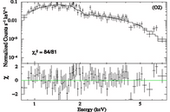
We report the discovery of the Fe K line emission at ∼6.62−0.06+0.06 keV with a width of ∼0.19−0.05+0.05 keV using two epochs of Chandra archival data for the nucleus of the galaxy 4C+37.11, which is known to host a binary supermassive black hole (BSMBH) system where the SMBHs are separated by ∼7 mas or ∼7pc. Our study reports the first detection of the Fe K line from a known binary AGN, which has an F-statistic value of 20.98 and a probability of 2.47 × 10⁻¹². Stacking two spectra reveals another Fe K line component at ∼7.87−0.09+0.19 keV. Different model scenarios indicate that the lines originate from the combined effects of accretion disk emission and circumnuclear collisionally ionized medium. The observed low column density favors a gas-poor merger scenario, where the high temperature of the hot ionized medium may be associated with the shocked gas in the binary merger and not with star formation activity. The estimated total BSMBH mass and disk inclination are ∼1.5 × 10¹⁰ M⊙ and ≳75°, indicating that the BSMBH is probably a high-inclination system. We were not able to tightly constrain the spin parameter using the present data sets. Our results draw attention to the fact that detecting the Fe K line emissions from BSMBHs is important for estimating the individual SMBH masses and the spins of the binary SMBHs, as well as for exploring their emission regions.
 IIA STALIN, C. S
Detection of X-ray polarization in the high synchrotron peaked blazar 1ES 1959+650
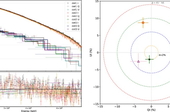
We report the measurement of X-ray polarization in the high synchrotron peaked blazar 1ES 1959+650. Of the four epochs of observations from the Imaging X-ray Polarimetry Explorer, we detected polarization in the 2–8 keV band on two epochs. From the model-independent analysis of the observations on 28 October 2022, in the 2–8 keV band, we found the degree of polarization of ΠX=9.0±1.6% and an electric vector position angle of ΨX=53±5 deg. Similarly, from the observations on 14 August 2023, we found ΠX and ψX values as 12.5±0.7% and 20±2 deg, respectively. These values are also in agreement with the values obtained from spectro-polarimetric analysis of the I, Q, and U spectra. The measured X-ray polarization is larger than the reported optical values, ranging between 2.5% and 9% when observed from 2008 to 2018. Broadband spectral energy distribution constructed for the two epochs is well described by the one-zone leptonic emission model with the bulk Lorentz factor (Γ) of the jet larger on 14 August 2023 compared to 28 October 2022. Our results favor the shock acceleration of the particles in the jet, with the difference in ΠX between the two epochs being influenced by a change in the Γ of the jet.
 IIA SUDHANSHU BARWAY
A Tale of NGC 3785: The formation of an ultra-diffuse galaxy at the end of the longest tidal tail
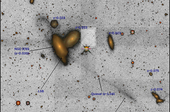
We present the discovery of an extended and faint tail observed in the isolated environment associated with galaxy NGC 3785. This study additionally provides observational evidence supporting the formation of ultra-diffuse galaxies (UDGs) at the end of the tail.
Methods. We utilized the Gnuastro software to detect and analyze the low surface brightness structures in the optical g- and r-bands using data from the Dark Energy Camera Legacy Survey. We created a detection map to identify the faint tail and measured its length using cubic spline fitting. Additionally, we found 84 star-forming clumps along the tail and performed photometric analysis on the tail portion after applying a significance threshold on the signal-to-noise ratio.
Results. We have measured the projected length of the tail, which is ∼390 kpc. We propose that this tail arises from the interaction of the NGC 3785 with a gas-rich galaxy, which ends up as a UDG at the end of the tail.
 IIA DIPANKAR BANERJEE
Exploring the dynamic rotational profile of the hotter solar atmosphere: A multiwavelength approach using SDO/AIA data
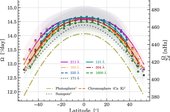
Understanding the global rotational profile of the solar atmosphere and its variation is fundamental to uncovering a comprehensive understanding of the dynamics of the solar magnetic field and the extent of coupling between different layers of the Sun. In this study, we employ the method of image correlation to analyze the extensive data set provided by the Atmospheric Imaging Assembly of the Solar Dynamic Observatory in different wavelength channels. We find a significant increase in the equatorial rotational rate (A) and a decrease in absolute latitudinal gradient (∣B∣) at all temperatures representative of the solar atmosphere, implying an equatorial rotation up to 4.18% and 1.92% faster and less differential when compared to the rotation rates for the underlying photosphere derived from Doppler measurement and sunspots respectively. In addition, we also find a significant increase in equatorial rotation rate (A) and a decrease in differential nature (∣B∣ decreases) at different layers of the solar atmosphere. We also explore a possible connection from the solar interior to the atmosphere and interestingly found that A at r = 0.94 R⊙ and 0.965 R⊙ show an excellent match with 171 Å, 304 Å, and 1600 Å, respectively. Furthermore, we observe a positive correlation between the rotational parameters measured from 1600 Å, 131 Å, 193 Å, and 211 Å with the yearly averaged sunspot number, suggesting a potential dependence of the solar rotation on the appearance of magnetic structures related to the solar cycle or the presence of cycle dependence of solar rotation in the solar atmosphere.
 IIA STALIN, C. S
Simultaneous x-ray and optical polarization observations of the blazar Mrk 421
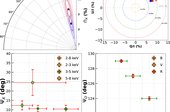
We present near-simultaneous X-ray and optical polarization measurements in the high synchrotron peaked (HSP) blazar Mrk 421. The X-ray polarimetric observations were carried out using Imaging X-ray Polarimetry Explorer (IXPE) on 2023 December 6. During IXPE observations, we also carried out optical polarimetric observations using 104 cm Sampurnanand telescope at Nainital and multiband optical imaging observations using 2 m Himalayan Chandra Telescope at Hanle. From model-independent analysis of IXPE data, we detected X-ray polarization with degree of polarization (ΠX) of 8.5% ± 0.5% and an electric vector position angle (ΨX) of 10fdg6 ± 1fdg7 in the 2−8 keV band. From optical polarimetry on 2023 December 6, in B, V, and R bands, we found values of ΠB = 4.27% ± 0.32%, ΠV = 3.57% ± 0.31%, and ΠR = 3.13% ± 0.25%. The value of ΠB is greater than that observed at longer optical wavelengths, with the degree of polarization suggesting an energy-dependent trend, gradually decreasing from higher to lower energies. This is consistent with that seen in other HSP blazars and favors a stratified emission region encompassing a shock front. The emission happening in the vicinity of the shock front will be more polarized due to the ordered magnetic field resulting from shock compression. The X-ray emission, involving high-energy electrons, originates closer to the shock front than the optical emission. The difference in the spatial extension could plausibly account for the observed variation in polarization between X-ray and optical wavelengths. This hypothesis is further supported by the broadband spectral energy distribution modeling of the X-ray and optical data.